
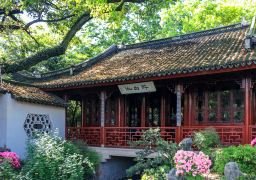
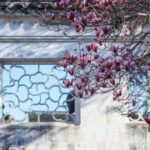
Zui Bai Chi is located in the old town of Songjiang and is a quintessential Jiangnan garden. The garden is filled with ancient trees and tranquil surroundings, offering a rare sense of elegance and peace amidst the bustling city. Although Zui Bai Chi is not large, it includes pavilions, towers, artificial mountains, and ponds, with intricate floral views visible through the latticed windows of the winding corridors. In summer, visitors can escape the heat and admire the lotus flowers, while in late autumn, they can enjoy the annual chrysanthemum exhibition. The garden also features numerous plaques, inscriptions, and stone carvings by renowned artists. As one of Shanghai’s five classical gardens (Yu Garden, Gu Yi Garden, Zui Bai Chi, Qiu Xia Pu, and Qu Shui Yuan), Zui Bai Chi is among the oldest. Originally a private residence during the Song Dynasty, it later became the residence of the late Ming Dynasty calligrapher and painter Dong Qichang. The existing garden was constructed by Qing Dynasty painter Gu Dashen on the original site. Zui Bai Chi, now a public park, is divided into an inner and outer garden. The outer garden is newly built, while the inner garden is the original classical garden. Visitors can enter the inner garden through the main entrance on Renmin South Road. Upon entering the outer garden, visitors are greeted by a brick-carved wall, with carvings depicting the scenic spots of Zui Bai Chi. Walking east along the tree-lined path, one can visit the recently relocated Qing Dynasty classical residence ‘Carved Flower Hall’, where the wood carving ‘Battle of Red Cliffs’ is worth seeing. Further ahead is a stone arch bridge, from which one can overlook the expansive lotus pond, especially during the summer and autumn when the lotus flowers are in full bloom, emitting a refreshing fragrance. The outer garden also features a large lawn, a rockery waterfall named ‘Wu Se Quan’, and a teahouse called ‘Reading Hall’. Passing through the cedar forest and entering from the western corridor leads to the inner garden. The central feature is a rectangular lotus pond, which is Zui Bai Chi itself. Strolling leisurely along the corridors surrounding the pond is a delightful experience. Although the inner garden is small, it is lush with flowers and trees, including many ornamental pines and bamboos. To the north of the pond stands a large camphor tree that is over three hundred years old, while to the east is a peony garden, and to the west behind the Snow Sea Hall is a golden and silver osmanthus garden. Various flower pots are often arranged around the pond and pavilions, especially during the chrysanthemum exhibition in mid-November, where visitors can see hundreds of chrysanthemum varieties. Additionally, adjacent to the south of the inner garden is a bonsai garden with beautiful scenery. The corridors in the inner garden connect various pavilions, including the Snow Sea Hall, Four Sides Hall, Pondside Thatched Cottage, Sedan Hall, and Le Tian Xuan, among others. These pavilions, mostly from the Qing Dynasty, exude an antique charm and are furnished with traditional redwood furniture according to ancient layouts. Under the eaves of the Pondside Thatched Cottage hangs a plaque inscribed by painter Cheng Shifa, titled ‘Zui Bai Chi’. In the southern part of the inner garden, there is an inscription gallery displaying many stone carvings by famous calligraphers and painters, including Zhao Mengfu’s ‘Ode to the Red Cliff’ from the Yuan Dynasty, Zheng Banqiao’s ‘Hard to Be Foolish’ from the Qing Dynasty, and a scroll written by Dong Qichang from the Ming Dynasty, all of which are distinctive features of Zui Bai Chi.
Zui Bai Chi is open from January 1st to April 30th from 07:00 to 17:00, and from May 1st to December 31st from 06:00 to 17:00. Concessions are available as follows: Elderly individuals aged 65 and above enter for free; those aged 60 to 64 enter at half price. Retired military and retired cadres with valid identification enter for free. Active-duty military personnel, martyrs’ families, and military spouses with valid identification enter for free. Disabled (military) individuals with valid identification enter for free. Children aged 6 and under, or under 1.3 meters in height (must be accompanied by an adult to enter the park), enter for free; children aged 6 to 18 with valid identification enter at half price. Students with full-time undergraduate or lower educational qualifications and valid student identification enter at half price.
Related Content:
 Shanghai’s Historical and Cultural Birthplace: Comprehensive Travel Guide to Songjiang District
 Off-the-Beaten-Path Travel Spots in Songjiang, Shanghai: Comprehensive Guide in One Article
 Autumn Splendor at Jiading Qiuxia Garden and Guyi Garden
 Zhouzhuang
 Qiuxia Garden: A Classical Shanghai Garden
 The Master of the Nets Garden