
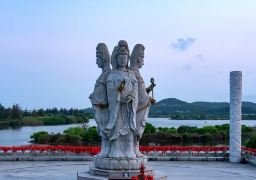
Nestled along the banks of the Wanquan River, the Boao Oriental Culture Garden is a cultural landmark of Boao and an excellent scenic spot to understand the human geography of Hainan. The garden consists of two parts: the Boao Zen Temple and the Oriental Culture Theme Park.
The Boao Zen Temple is constructed according to the orthodox Zen temple regulations, with a north-south central axis featuring the Tonghui Gate, Puji Hall, Mahavira Hall, and the Ten Thousand Buddhas Pagoda. To the east and west, there are bell and drum towers, eastern and western wings, abbot’s quarters, guest halls, and monks’ dormitories. Among them, Puji Hall enshrines twelve distinctive ‘Avalokitesvara Statues’; the ‘Ten Thousand Buddhas Pagoda’ stands at an elevation of 77 meters, with a height of 55 meters, making it one of the tallest structures in the Boao area. Inside the pagoda, there is a 16.8-meter-tall bronze statue of the Thousand-Armed and Thousand-Eyed Avalokitesvara Bodhisattva, which is rare in Asia.
The backyard of the Boao Zen Temple is affiliated with the Oriental Culture Theme Park and the Lotus Pavilion. The Oriental Culture Theme Park is a comprehensive large-scale tourist attraction that emphasizes Buddhist culture as its core connotation. The Lotus Pavilion is a lotus-themed science and culture museum built to museum standards, showcasing the history, culture, technology, and economic value of the lotus through digital means. Opening hours are from 8:00 to 18:00 all year round. Must-see tips: 1. In the water tour line of the Boao Oriental Culture Garden, there is a small island with an area of only 6 square meters called ‘Lotus Platform’, which is listed as one of the ‘Eight Sceneries of Yuehui’ in the Qing Dynasty’s ‘Luehui County Chronicles’. Local folklore says the island is the lost lotus throne of Guanyin. ‘Qionghai County Chronicles’ records that there was a Ming Dynasty stone tablet on the island inscribed with ‘Lotus Zen’, where local people would come to offer incense and pray for safety before going out to sea. 2. ‘Dahe Lotus’: In 1951, in Chiba Prefecture, Japan, an ancient ship that had come to China over two thousand years ago and three ancient lotus seeds were discovered. Dr. Dahe Ichiro, a botanist, cultivated the seeds into a new lotus, named ‘Dahe Lotus’. In 2003, Japanese friend Fujii Toshihiro brought the Dahelotus back to China, taking root in Boao.
Related Content:
 Menghuan Great Golden Pagoda, Asia’s First Hollow Buddhist Pagoda
 Ocean Flower Island Tourist Resort
 Suzhou, Shanghai, Zhejiang: A 3-Person Self-Drive Adventure
 National Day Holiday: Exploring the Shimao InterContinental
 Follow Xia Ningbao to the Jiangnan water town – Zhujiajiao Ancient Town.
 Qingxi Country Park, A Good Place for Autumn Outings