
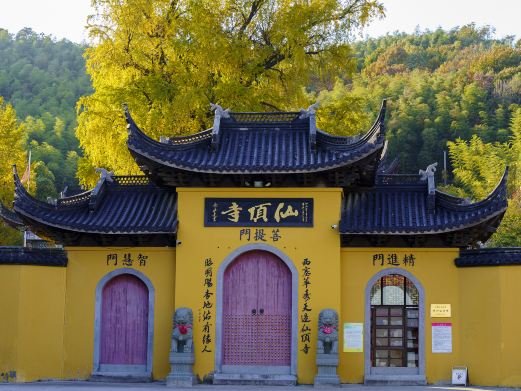
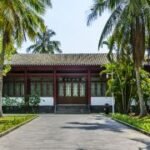
Huili Temple is located at the southern foot of Xishan Mountain in Xiashi. It was first built by Zhang Yanguang, a minister in the Ningkang period (373 – 375) of the Eastern Jin Dynasty as Zhiyuan Temple. It was destroyed by war in the late Tang Dynasty. It was rebuilt in 964, the second year of Qiande in the Northern Song Dynasty. In 1009, the second year of Dazhong Xiangfu in the Northern Song Dynasty, it was granted the name Huili Temple. At that time, the mountain gate, main hall, and meditation hall were all magnificent and spacious. There were 72 monk rooms surrounding Xishan Mountain up and down. It was repaired several times in the Yuan, Ming, and Qing dynasties. In the Qingming Festival of 1926, the temple was destroyed by fire, leaving only the main hall. In the early 1980s, the main hall was rebuilt, retaining a bit of the atmosphere of the ancient Sanskrit characters. The two Tang Dynasty stone stupas related to Huili Temple were built in 874 AD. The stupa is 4.9 meters high and has eight sides. Below is the Xumizuo base, and above it is covered with a canopy and a lotus treasure top. It is engraved with the Sutra of the Glorious Dharaṇī and reliefs of lotus and beast faces, showing a glimpse of the ‘Tang Dynasty engraving’ art. Relevant knowledge: During the Wei, Jin, Southern and Northern Dynasties, Buddhism was protected by emperors. It became fashionable for high officials and dignitaries to donate their houses to build temples. As a result, Sakyamuni flourished greatly. In Jiaxing City, in the two to three hundred years from 214 AD to 519 AD, there were famous temples such as Jingyan Temple, Jingxiang Temple, Xingshan Temple (Jiaxing), Jinshu Temple, Faxi Temple, Zisheng Temple (Haiyan), Huili Temple (Xiashi, Haining), Miyin Temple, Chongfu Temple, Zhiyuan Temple, Fuyan Temple (Tongxiang), Ciyun Temple (Weitang, Jiashan) and Changfu Temple (Pinghu). Opening hours: The specific business status is subject to the opening situation on the day.
Related Content:
 Suzhou, Shanghai, Zhejiang: A 3-Person Self-Drive Adventure
 Jiangnan Song City: Scenic Beauty, Hakka Cradle, and Fun in Ganzhou!
 Follow Xia Ningbao to the Jiangnan water town – Zhujiajiao Ancient Town.
 Dongpo Academy
 Danzhou Dongpo Cultural Tourism Area
 Whispers of the Great Mountains: A 3-Day Self-Driven Tour in Liangshan Yi Autonomous Prefecture