
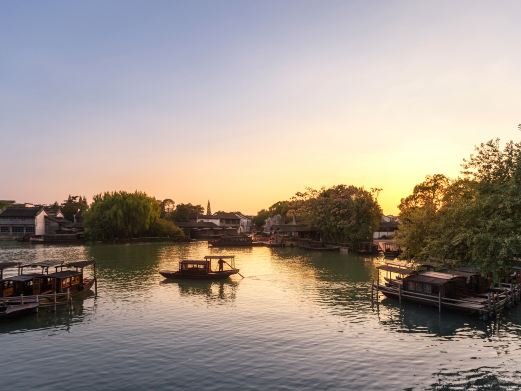
In the Ming Dynasty, the Jiangsu-Zhejiang Branch Office was called the Zhejiang-Zhi Branch Office. It was responsible for patrolling salt and arresting thieves, and also handling local lawsuits. It is commonly known as the second government office. Since its establishment during the Jiajing period of the Ming Dynasty, it has undergone several reforms and relocations, lasting for more than 370 years. In 2004, the Jiangsu-Zhejiang Branch Office was rebuilt on its original site according to its old appearance during the Tongzhi period of the Qing Dynasty to preserve historical relics. Among them, rooms such as the courtroom, jail, torture room, errand boys, and coachmen are all on display. There are also various simulated execution scenes on display, from which one can glimpse the ancient government affairs and living scenes.
History: Wuzhen is located at the junction of two provinces, three prefectures, and seven counties. It is densely populated, with crisscrossing rivers and ports. It is difficult to govern the mixed population. It is easy for villains to hide. In the 19th year of Jiajing in the Ming Dynasty, an assistant magistrate was added and stationed in the town to supervise. The office was built to the east of Pujing Temple and was named the additional office. In the third year of Wanli, due to the rampant salt thieves around Wuzhen, an assistant magistrate in charge of general arrest was added. The official seal of ‘Supervising Salt Patrol and Arresting Thieves Assistant Magistrate’ was granted. He was stationed in Wuzhen all year round, solely responsible for arresting thieves, and also in charge of water conservancy and salt laws. He casually accepted lawsuits and eliminated evils. The nearby prefectures and counties were all subject to his restraint. As a result, the original office buildings were expanded and called the Zhejiang-Zhi Branch Office. In the early Qing Dynasty, the establishment of the Ming Dynasty was followed, and it experienced repeated rises and falls. In the war in the 10th year of Xianfeng, the main hall was destroyed. It was rebuilt in the fourth year of Tongzhi. In 1915, it was sold to the public at a price. The office buildings were removed and gradually became private residences.
Related Content:
 Spring Outing and Admiring Flowers, Live up to the Spring Scenery. A Brief Note on Cherry Blossom Appreciation in Wuxi, Jiangsu in March 2023
 Suzhou, Shanghai, Zhejiang: A 3-Person Self-Drive Adventure
 Jiangnan Song City: Scenic Beauty, Hakka Cradle, and Fun in Ganzhou!
 Follow Xia Ningbao to the Jiangnan water town – Zhujiajiao Ancient Town.
 Self-guided Tour of Five Places in Eight Days: Shanghai, Guangzhou, Zhaoqing, Macau and Nanjing
 Danzhou Dongpo Cultural Tourism Area