
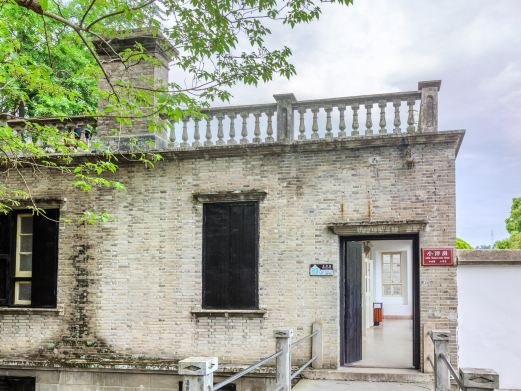
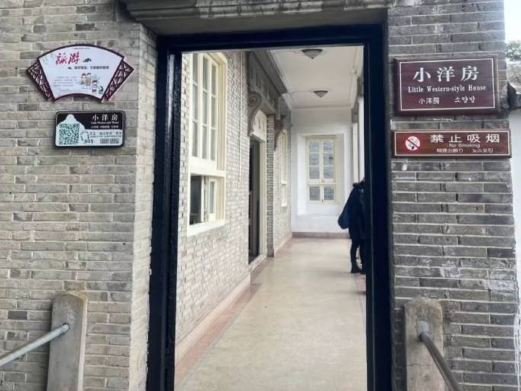
This small two-story house with three rooms was built in 1930. Due to its small structure and the use of cement as building material, which was also called ‘foreign cement’, it got the name ‘Small Western-Style House’, also known as ‘Xiaozhu by the Shanxi River’ and ‘Hanzhai’. It is located on the east side of Wenchang Pavilion and is connected to Wenchang Pavilion by an open-air corridor. In April 1937, Chiang Ching-kuo returned from studying in the Soviet Union. Chiang Kai-shek arranged for him to live and study here. While taking Chinese language tutoring and studying works such as Letters from Zeng Guofan, Complete Works of Wang Yangming, and ‘Heritage of Chinese Literature’, he was also asked to write the ‘Report on Traveling in Russia’ to reflect on the red imprint left during his study in the Soviet Union and ‘brainwash’ his son. Chiang Ching-kuo recorded it as ‘Hanzhai’ in his diary and jokingly compared it to a’study for cultivating body and mind and increasing self-restraint’. When Chiang Ching-kuo was living and studying here, on the upper floor, the east side was the bedroom, the west side was the study, and in the middle was the living room. The Small Western-Style House was also once inhabited by Endicott, Chiang Kai-shek’s foreign military adviser, and Chen Bulei, director of the General Staff Office. Inside on the first floor of the Small Western-Style House, there is a stone tablet with the inscription ‘Wash Blood with Blood’, which tells the history of the death of Chiang Ching-kuo’s mother, Mao Fumei. On December 12, 1939, Japanese invaders’ planes bombed Xikou. Mao Fumei was unfortunately crushed to death by the collapsed rear wall at the back door of Fenghaofang. After hearing the news, Chiang Ching-kuo hurriedly came back from Jiangxi to mourn. In grief and anger, he wrote down four big characters ‘Wash Blood with Blood’, expressing his firm determination to avenge his mother’s death.
The opening hours are subject to consultation with the scenic area for specific times.
Related Content:
 Self-guided Tour of Five Places in Eight Days: Shanghai, Guangzhou, Zhaoqing, Macau and Nanjing
 Sun Yat-sen’s Former Residence Memorial Hall in Shanghai
 The Mastermind Behind Asia’s Top Female Chef: Tiger Boss
 Suzhou, Shanghai, Zhejiang: A 3-Person Self-Drive Adventure
 839th Episode: Bustling Eastern Water Capital, Twin Dragons Play Pearls on the Huangpu River Beach
 A Tranquil Escape to Anlu: A Three-Day, Two-Night Journey into the Past with My Child