
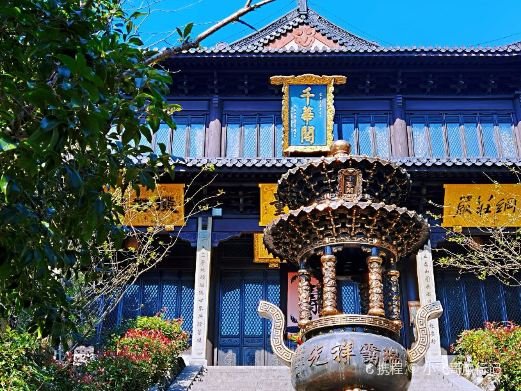
Wulei Temple is located at the southern foot of Xiangwang Peak in Wulei Mountain, Guanhaiwei Town, Cixi City. According to historical records such as the ‘Cixi County Annals’ during the Guangxu period, the embryonic form of Wulei Temple emerged in the 3rd century AD.
Wulei Temple boasts numerous historical sites and scenic spots. In front of the temple gate, there is a pond named ‘Zheming Pool’, where clear water gushes out from the elephant’s eye tomb in the east and flows into the Zheming Pool, then through a small canal to the Moon Lake, never drying up throughout the year. It is said that this was also created by the Indian monk Naroyan leading his disciples to dig day and night, during which they fought with demons in the mountains, resulting in many casualties, hence it is also called the ‘Ten Thousand Workers Pool’, and the water in the pool is clear, sweet, and refreshing.
Related Content:
 Suzhou, Shanghai, Zhejiang: A 3-Person Self-Drive Adventure
 West of Tibet, Towards the Scorching Mountains and Rivers
 Winter Tour in Mingyue Mountain, Jiangxi. Play with snow on the mountain and soak in hot springs at the foot. See waterfalls and floating clouds and take a small train. Beautiful scenery and fun activities.
 Jiangnan Song City: Scenic Beauty, Hakka Cradle, and Fun in Ganzhou!
 Follow Xia Ningbao to the Jiangnan water town – Zhujiajiao Ancient Town.
 Spring Outing and Admiring Flowers, Live up to the Spring Scenery. A Brief Note on Cherry Blossom Appreciation in Wuxi, Jiangsu in March 2023