
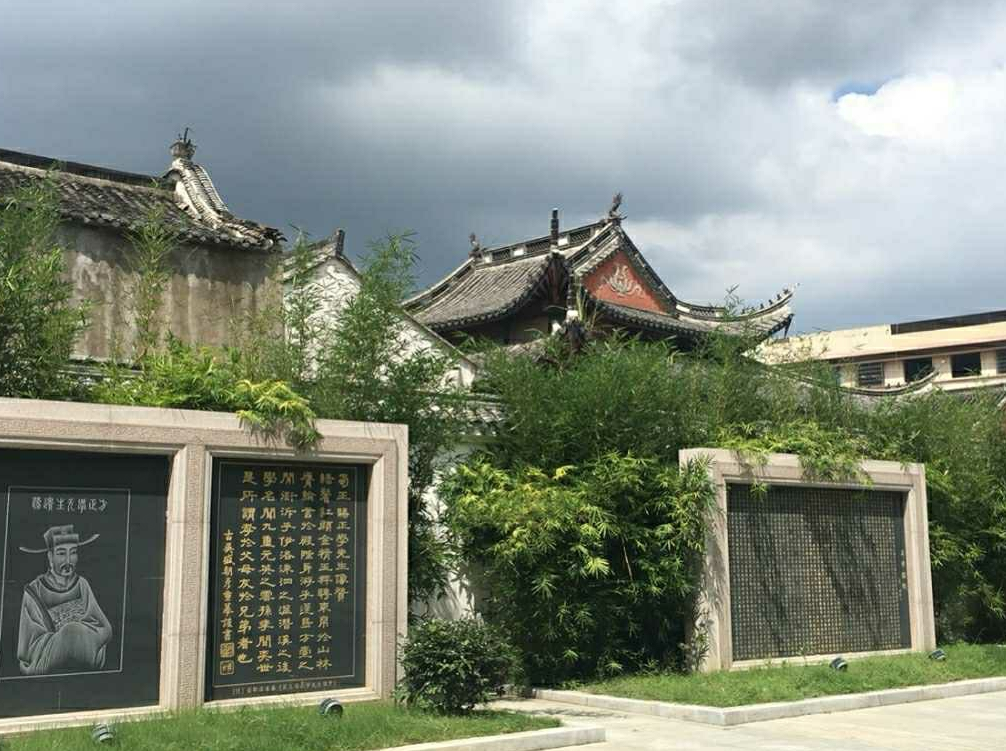
The Wang Xitong Uprising Site, a provincial-level key cultural relics protection unit, is located at No. 20 Taoyuan South Road, Ninghai County, originally the City God Temple, which was first built during the Tang Guangde period. The existing structure was reconstructed in the 24th year of the Qing Jiaqing era (1819). The main building complex consists of four sections, arranged from south to north along the central axis as the screen wall, Wu Feng Pavilion, stage, Pan Xuan, main hall, and rear palace.
Auxiliary buildings include the platform gate, Zong Cao Hall, Wuchang Hall, east and west viewing rooms, and the treasury, with a total construction area of 1244 square meters, making it one of the larger ancient buildings in Ninghai County. Among them, the Wu Feng Pavilion features a curved roof. The beams of the pavilion are engraved with exquisite carvings, the ceiling of the stage is spirally stacked with intricate patterns, and the Ruyi brackets on the eaves project layer by layer. The top features vivid dragons and phoenixes, symbolizing auspiciousness.
Related Content:
 National Day Holiday: Exploring the Shimao InterContinental
 Suzhou, Shanghai, Zhejiang: A 3-Person Self-Drive Adventure
 A Tranquil Escape to Anlu: A Three-Day, Two-Night Journey into the Past with My Child
 Zhengzhou – Nanjing – Wuxi – Shanghai, Leisure Self-driving All the Way, Feel the Midsummer Time!
 Jiangnan Song City: Scenic Beauty, Hakka Cradle, and Fun in Ganzhou!
 Summer Vacation in Shanghai: Must-Visit Spots to Bookmark