
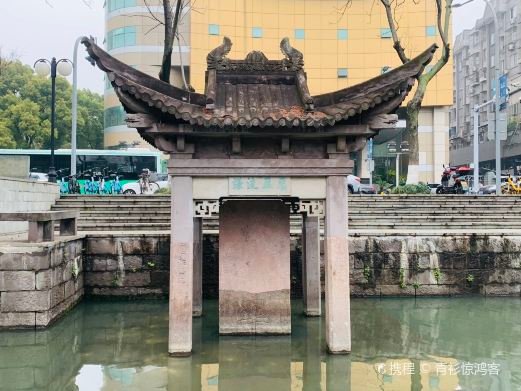
The Water Gauge Stele is located at the intersection of Pingqiao Street on the west side of Zhenming Road in Haishu District, Ningbo City (originally Pingqiao River). It was built during the Baoyou period (1253-1258) of the Song Dynasty. It was continuously repaired in the Ming and Qing dynasties. Most of the current stone pavilion architecture was built during the Daoguang period of the Qing Dynasty. It retains the pavilion foundation of the Southern Song Dynasty and the rebuilt’steady’ character stele of the Ming Dynasty. The Water Gauge Pavilion was built for the water gauge stele. The pavilion is under the Siming Bridge, located in a moderate place. It measures the water potential and engraves the character’steady’ on the stone. The sluice gates outside the city are opened and closed according to the appearance and disappearance of the character’steady’. When the water submerges the character’steady’, it should be discharged. When the character’steady’ appears, it should be stored. The opening and closing are appropriate, and there is no worry of drought or flood for the people. Therefore, the Siming Bridge was renamed Pingqiao Bridge. The Water Gauge Pavilion has played an important role in ensuring a bountiful harvest of crops and the safety of prefectures and counties. The Water Gauge Stele uses the principle of steady water to achieve the purpose of observing disasters and unifying the dispatch of people’s conditions. It is the only existing example among the ancient urban water conservancy remains in China. It is a rare physical example for studying the history of water conservancy development and urban drainage and flood control water conservancy projects and has special significance. Open all year round, open all day.
Related Content:
 Follow Xia Ningbao to the Jiangnan water town – Zhujiajiao Ancient Town.
 Suzhou, Shanghai, Zhejiang: A 3-Person Self-Drive Adventure
 Jiangnan Song City: Scenic Beauty, Hakka Cradle, and Fun in Ganzhou!
 Whispers of the Great Mountains: A 3-Day Self-Driven Tour in Liangshan Yi Autonomous Prefecture
 National Day Holiday: Exploring the Shimao InterContinental
 839th Episode: Bustling Eastern Water Capital, Twin Dragons Play Pearls on the Huangpu River Beach