
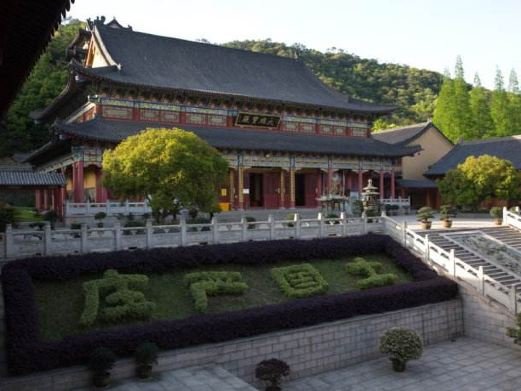
The Ruiyan Temple in Ningbo is located in Beilun District, Ningbo City. Ruiyan Temple was founded in the Tang Dynasty and has a history of more than 1,500 years. During the Huichang period of the Tang Dynasty, Master Puhua established a hermitage here. After several rises and falls. In 1904 AD (the thirtieth year of the Guangxu period of the Qing Dynasty), it became famous for being granted the Dragon Tripitaka. Together with Tiantong Temple and Ashoka Temple adjacent to the mountain, it became a famous temple in eastern Zhejiang. Ruiyan Temple wins with its scenery. The twelve peaks behind the temple are indigo and green, with endless changes and scattered meandering. In front of the temple, Zhishui Creek winds and loops. The creek stones are mixed. There are many creek bridges. The creek water flows continuously and becomes the source of Lujiang River. There are ancient trees towering around. The twelve peaks, Lingzhi Mountain, Shizhu Pool, Dishui Rock, Lvyun Screen, Zhishui Bridge, Feishi Pit, Jianyue Pavilion, Shijun Pavilion, and Jushi Hall are known as the ten scenic spots of Ruiyan. It can be seen that the incense was once prosperous and the scenery was beautiful. Nowadays, the large environment around Ruiyan Temple has not changed much. Only most of the main buildings of Ruiyan Temple no longer exist. The remaining Tripitaka building, ancient fragrant path, ancient stone bridge, release pond and some inscriptions are still preserved. And the original mixed creek stones have also become regular stone-lined canals due to the reclamation and planting of tea gardens and orchards. In addition, due to the construction of reservoirs, some of the ancient fragrant paths have also sunk into the silent underwater. Other cultural attractions include small folk temples such as Xiaotianlong Temple on the southeast side of Wang’ao Village and Foyan Temple in Chenjia Village. The specific business hours and status are subject to the opening situation on the day.
Related Content:
 Follow Xia Ningbao to the Jiangnan water town – Zhujiajiao Ancient Town.
 Suzhou, Shanghai, Zhejiang: A 3-Person Self-Drive Adventure
 Jiangnan Song City: Scenic Beauty, Hakka Cradle, and Fun in Ganzhou!
 Spring Outing and Admiring Flowers, Live up to the Spring Scenery. A Brief Note on Cherry Blossom Appreciation in Wuxi, Jiangsu in March 2023
 West of Tibet, Towards the Scorching Mountains and Rivers
 National Day Holiday: Exploring the Shimao InterContinental