
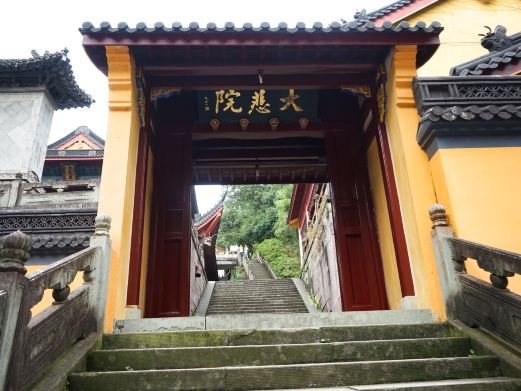
The Dabei Courtyard (Guanyin Pavilion) was built in 1998 and completed in 1999. It is composed of Dabei Pavilion, Huazang World, Mingxin Building, Patriarch Hall, and Chanting Hall. The main hall, Dabei Pavilion, has a magnificent and exquisite architecture. Its shape reflects the combination of dignity and gracefulness of Guanyin, and a sense of stability within kindness, achieving a harmony between solemnity and vividness, and a unity of grandeur and delicacy. The two-story building has five bays, with a total width of 18.87 meters, a total depth of 16.83 meters, a height of 20.84 meters, and a construction area of 961 square meters. In the lower hall, there is a statue of the Free Guanyin standing on a lotus pedestal, which is 7.5 meters high. In the upper level, there is a statue of Thousand-Handed and Thousand-Eyed Guanyin and her 32 manifestations. The Thousand-Handed Guanyin actually has 42 hands. The two central hands are joined in greeting, while the other 40 hands each hold a ritual implement. There is an eye painted on the palm of each hand. It is said that each hand has 25 functions. With a thousand hands and a thousand eyes, it symbolizes the profound compassion and great vows of Avalokitesvara. Avalokitesvara is always loved by devout men and women as she responds to people’s needs and benefits all living beings. At the south end in front of Dabei Pavilion is the ‘Huazang World’, which enshrines Vairocana Guanyin. The four walls are decorated with mirrors, which can reflect an infinite number of Buddha statues, forming a world of three thousand Buddhas. The Huazang World was created by the eminent monk Fazang (634 – 712) in the Tang Dynasty and is designed according to the ‘Golden Lion Chapter’ of the Avatamsaka Sutra. Skillfully using ten mirrors makes the Buddha statues shine on each other and form countless images. In front of Dabei Pavilion, there is a brick-carved screen wall, which is elegant and generous, 16.2 meters long and 5.8 meters high. The front side of the brick carving shows eighteen arhats worshipping Guanyin.
To the north of the pavilion are the ‘Patriarch Hall’ and ‘Chanting Hall’. Behind the pavilion is the ‘Mingxin Building’, a two-story guesthouse that welcomes distinguished guests and pilgrims from home and abroad.
Related Content:
 839th Episode: Bustling Eastern Water Capital, Twin Dragons Play Pearls on the Huangpu River Beach
 Zhengzhou – Nanjing – Wuxi – Shanghai, Leisure Self-driving All the Way, Feel the Midsummer Time!
 Suzhou, Shanghai, Zhejiang: A 3-Person Self-Drive Adventure
 The Coolness Harvested at Shanghai Haichang Ocean Park in the Late Summer of 38 Degrees
 Dreams Come True: Unlocking Shanghai’s World-Class Internet Celebrity Landmarks
 West of Tibet, Towards the Scorching Mountains and Rivers