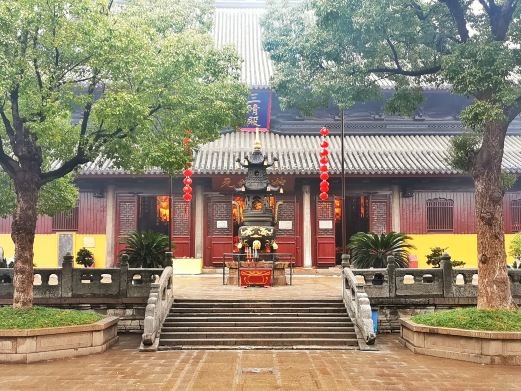
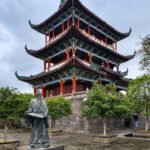
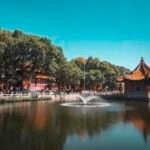
Xuanmiao Taoist Temple, originally constructed in the second year of the Xian Ning era during the Western Jin Dynasty (AD 276), has a history of over 1700 years.
In the early Qing Dynasty, to avoid the taboo of Emperor Kangxi’s name Xuanye, it was renamed ‘Yuanmiao Temple’.

At its zenith, Xuanmiao Temple boasted over 30 palaces and was one of the largest Taoist temples in the country.
The Sanqing Hall, built during the sixth year of the Chunxi era of the Southern Song Dynasty (AD 1179), features a double-eaved, hip-and-gable roof, standing majestic and splendid, and is one of the largest wooden ancient constructions in the Jiangnan region.
The temple enshrines a 17-meter-tall statue of the Three Pure Ones (Shangqing, Yuqing, and Taiqing), which is considered an excellent example of Song Dynasty sculpture.
Within Xuanmiao Temple, there are existing steles including the painting of Laozi by Tang Dynasty artist Wu Daozi, inscriptions by Emperor Xuanzong, and calligraphy by Yan Zhenqing, all meticulously engraved by Song Dynasty master carver Zhang Yundi, known as the ‘Four Unique’ steles.
This is one of the only two remaining steles of Laozi in the country, making it extremely precious and attracting numerous pilgrims and tourists from afar.
Opening hours are from 07:30 to 17:00 all year round.
Preferential policies: Children under 6 years old (inclusive) or under 1.4 meters in height (inclusive) enter for free;
Students, children, and the elderly: Full-time primary, middle, and high school students (including undergraduates and below) and elderly people aged 60 to 70 (inclusive of 60, exclusive of 70) can purchase discounted tickets with valid identification;
Discounted tickets for the elderly: Elderly people aged 70 and above (inclusive) enter for free with valid identification;
Free entry for military personnel: With soldier’s ID, police officer’s ID, officer’s ID, civilian cadre’s ID, military retired cadre’s ID, revolutionary disabled soldier’s ID, entry is free;
Free entry for disabled people: With a disability card issued by the China Disabled Persons’ Federation, and one accompanying person for severely disabled individuals (severely disabled individuals refer to: first and second level blind, intellectual, physical, mental, multiple disabilities) with valid identification, entry is free;
Free entry for religious personnel: Taoist clergy with valid identification enter for free.
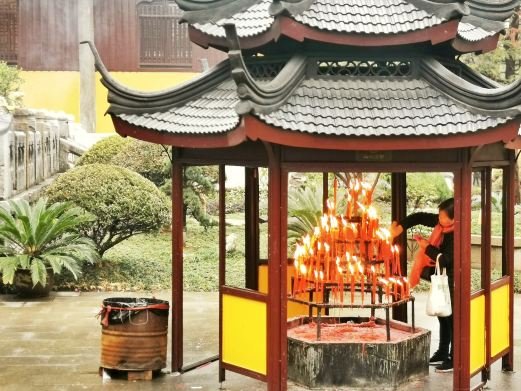
Additional notes: From Chinese New Year’s Eve to the fifth day of the Chinese New Year, the scenic area implements a universal incense ticket charging model, with each ticket priced at 20 yuan.
The above information is for reference only; specific details are subject to the official announcements at the scenic spot.