
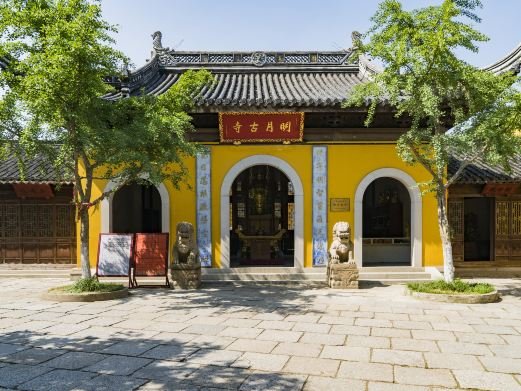
The Mingyue Temple was built in the second year of Qingtai in the Later Tang Dynasty (935 AD) and was founded by monk Zhiming. At the beginning of the Hongwu period of the Ming Dynasty, it was merged into the Puxian Temple. In 1890 AD (the sixteenth year of Guangxu in the Qing Dynasty), monk Daogen renovated it. It was destroyed during the “Cultural Revolution” and was restored and opened in 1993. There was originally a large area of pear forests near the Mingyue Temple. Every early spring, “thousands of trees and tens of thousands of pear blossoms bloom”, becoming a scene in the ancient town. Li Guo of the Qing Dynasty had the sentence “Pear blossoms in Mingyue Temple, fragrant grass and cattle-herding hut”, which was widely recited for a while. The architecture of the Mingyue Temple is quite distinctive. The layout structure of the Mahavira Hall and the Sutra Depository is similar to that of the nearby Lingyan Mountain Temple. The Mahavira Hall is the center of the Mingyue Temple architectural complex. There are five main halls with two-story upturned eaves, solemn, magnificent and splendid. In the center of the main hall, Tathagata Buddha is enshrined. On both sides are Amitabha Buddha and Bhaisajyaguru Buddha, collectively known as the “Three Buddhas of the Past, Present and Future”. Behind the Buddha statue, Avalokitesvara Bodhisattva is enshrined. Standing on a lotus flower and holding a willow branch with a pure bottle, she has a reserved and gentle demeanor.
Opening hours: 8:00 – 16:30 (winter), 8:00 – 17:00 (summer).
Related Content:
 Winter Tour in Mingyue Mountain, Jiangxi. Play with snow on the mountain and soak in hot springs at the foot. See waterfalls and floating clouds and take a small train. Beautiful scenery and fun activities.
 Lushan Scenic and Historic Interest Area
 Hongyin Mountain Villa
 Fu’an Baiyun Mountain
 Yanoda Rainforest Cultural Tourism Area
 Huiji Temple