
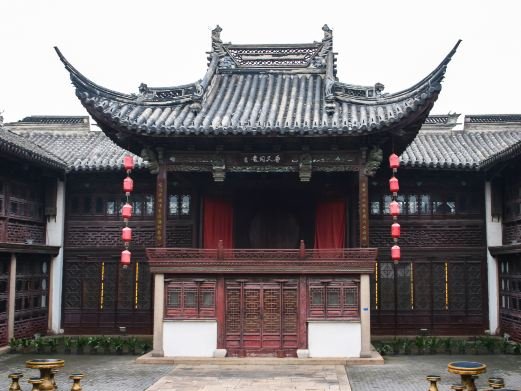
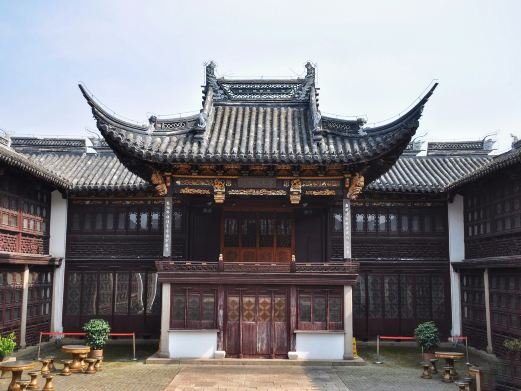
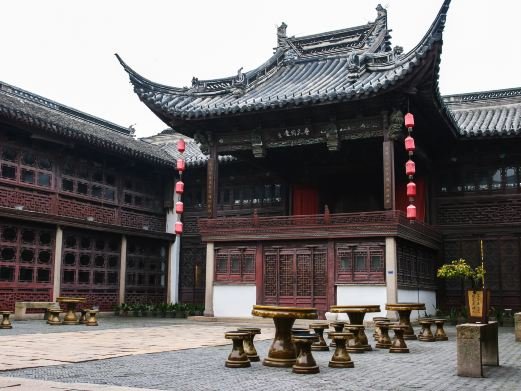
Kunqu is known as the ‘ancestor of all operas’. It has elegant lyrics and beautiful rhythm. It is one of China’s first batch of intangible cultural heritages, and its birthplace is Suzhou. The China Kunqu Museum aims to rescue, protect, inherit and promote Kunqu art. Its main functions are to collect, research, display and perform Kunqu heritage. It not only displays tangible Kunqu cultural relics and materials, but also displays intangible traditional Kunqu art. The site of the Kunqu Museum was originally the Quan Jin Guild Hall. It is one of the more than 100 guild halls and offices in Suzhou’s history that has been relatively completely preserved so far. Here, you can see the engraved edition of ‘Huan Gan Ji’ of the Ming Dynasty, the handwritten copy of ‘Peony Pavilion – Visiting the Garden’ during the Qianlong period of the Qing Dynasty, the exquisitely carved mahogany opera boat, the lamp-decorated Kunqu hall name plaque inlaid with jade and precious stones, the story-telling figurine unearthed from the tomb of Emperor Xuan of the Western Han Dynasty, Ma Rufei’s story-telling notebook ‘Dream History’, the pipa once used by Xue Laqing, the king of pipa. There are also two levels of opera text models of ‘Drunken Return’ and ‘Dangling Lake Boat’, a set of 24 ancient court musical instrument double-tone chime bells, a set of 37 cloud offerings, and the same view of musical instruments unearthed from Neolithic cultural sites.
Opening hours: Open all year round. Tuesday to Sunday, 09:00 – 17:00.
Must-see tips: 1. There are regular performances at two o’clock in the afternoon every Sunday in the museum. 2. It is close to Ou Garden and can be reached on foot.
Related Content:
 Jiangnan Song City: Scenic Beauty, Hakka Cradle, and Fun in Ganzhou!
 Self-guided Tour of Five Places in Eight Days: Shanghai, Guangzhou, Zhaoqing, Macau and Nanjing
 Summer Vacation in Shanghai: Must-Visit Spots to Bookmark
 The Master of the Nets Garden
 Suzhou, Shanghai, Zhejiang: A 3-Person Self-Drive Adventure
 Exploring the Roots of Shanghai: The Charm of Songjiang as an Internet Sensation