
Lingshan Grand Canyon, a renowned tourist attraction, is located in Guangde County, Anhui Province, at the confluence of the Huangshan and Tianmu mountain ranges.
The scenic area is composed of five major tourism functional zones: the Lingshan Gorge Exploration Area, the Lingshan Temple Buddhist Cultural Area, the Qingmeizhuang Leisure Area, the Wei Village Folklore Experience Area, and the Bamboo Sea City Resort Area.
Within the Lingshan Grand Canyon, there are serene streams, towering and dangerous peaks, high-suspended waterfall groups, and a variety of peculiar rocks scattered throughout. It boasts 72 scenic spots, including Yunjin Waterfall, Caiyun Stream, Sanlian Waterfall, Xiangshuitan, and the God Turtle Carrying Scriptures.
There is also the ancient Lingshan Temple, which is as famous as Lingyin Temple and is known as a Buddhist holy land, originally built during the Sui and Tang dynasties. The incarnation of Ksitigarbha Bodhisattva, Prince Kim Jo-gak, and the Buddha of Dingguang, Great Wisdom Zonggao, have both practiced meditation here, and the temple still enjoys a thriving incense.
The Lingshan scenic area is charming, integrating mountains, water, stones, waterfalls, temples, forests, and caves into one, and has been favored by literati and tourists since ancient times. It was once praised as ‘the best of Lingshan springs and stones in the county’. The Song Dynasty politician and literary scholar Fan Zhongyan visited here and gave a high praise of ‘Lingshan in the south, and the Great Cave (Tai Chi Cave) in the north’.
Related Content:
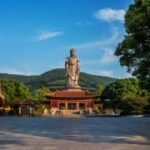 Grand Buddha at Lingshan Mountain
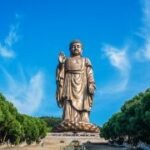 Lingshan Scenic Area: A Majestic Buddhist Sanctuary
 Spring Outing and Admiring Flowers, Live up to the Spring Scenery. A Brief Note on Cherry Blossom Appreciation in Wuxi, Jiangsu in March 2023
 Follow Xia Ningbao to the Jiangnan water town – Zhujiajiao Ancient Town.
 West of Tibet, Towards the Scorching Mountains and Rivers
 Suzhou, Shanghai, Zhejiang: A 3-Person Self-Drive Adventure