
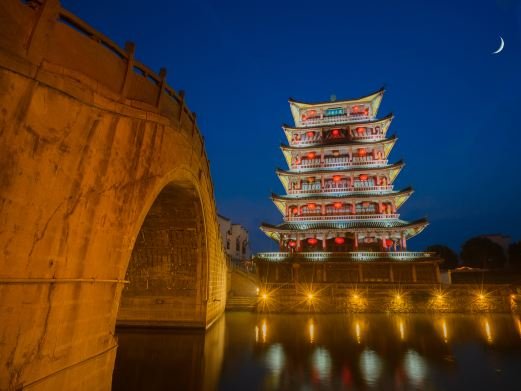
Sanhe Ancient Town is located about 40 kilometers south of Hefei urban area. It is named after the three rivers, Fengle River, Hangbu River and Xiaonan River, flowing through it. The ancient town developed from the ancient docks on the Sanhe River. It has a history of more than 2500 years. In the Spring and Autumn Period, it was called Que’an. It was first called Sanhe Town in the Ming Dynasty. In 1858, Chen Yucheng and Li Xiucheng of the Taiping Heavenly Kingdom defeated the Qing army here, known as the ‘Great Victory of Sanhe’. The old street in the ancient town is paved with bluestone slabs, which have been polished smooth by people and vehicles over thousands of years. The Huizhou-style buildings on both sides are unique. Many of them are directly built with blue bricks as walls. The upturned eaves on the horse-head walls are much more exaggerated than those on the horse-head walls in Hongcun and Xidi.
The tour guide generally starts to visit the ancient town from the town center. After taking a long-distance bus to Sanhe Bus Terminal, turn right and walk for 10 minutes. Passing through the Dajie Gate archway built to commemorate the ‘Great Victory of Sanhe’, you will come to the three-arch stone bridge Sanxian Bridge in the town center. It is named because it is at the intersection of Feixi County in Hefei City, Lujiang County, and Shucheng County in Lu’an City. The north-south flowing Xiaonan River flows under the bridge.

To the northwest of Sanxian Bridge is the Guocui Tower, which is seven stories high. Climbing the tower, you can overlook the panorama of Sanhe Ancient Town. Inside the tower are displayed exquisite Huizhou-style cultural relics such as sedans, plaques, carved beds, and stone carvings.
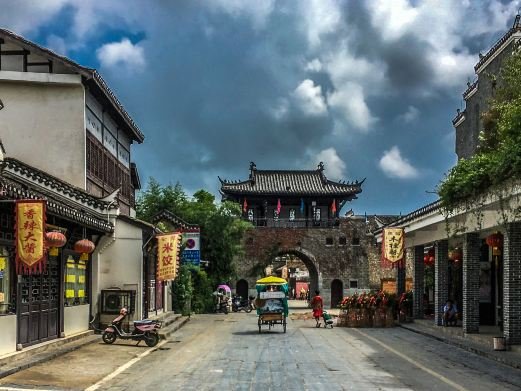
The cultural relics exhibited in the Dafudi (Sanhe Folk Custom Museum) near Guocui Tower are also exquisite, including the hall layout of an official’s private residence, beautiful wood carvings, and a 1.5-meter-long abacus.
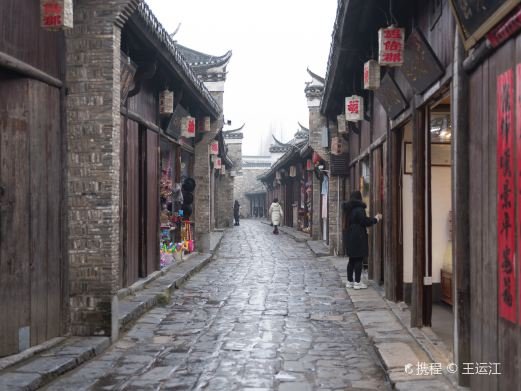
To the northeast of Sanxian Bridge is the Xiangu Tower (the former site of Zhonghexiang), a Huizhou-style residential temple built by a big businessman at that time.
Food and accommodation. The snacks in Sanhe Ancient Town are concentrated around Sanxian Bridge. There are more restaurants in the south of the ancient town than in the north. Special delicacies include Sanhe rice dumplings, Sanhe shrimp paste, crispy duck, river delicacies such as mussels and snails. Tea dried, which is a kind of dried tofu, can be bought and eaten while walking. Rice wine is also good to take home as a gift. As for characteristic souvenirs, feather fans can be purchased. There are accommodations in and around the ancient town. They are not expensive, around 100-200 yuan. However, almost no tourists stay overnight in the ancient town. After visiting, you can return to Hefei urban area on the same day. Accommodation is not very necessary.
Opening hours. Open all year round and all day. The opening hours of internal small scenic spots and sculling boats are from 8:30 to 17:30.Related Content:
 Follow Xia Ningbao to the Jiangnan water town – Zhujiajiao Ancient Town.
 Self-guided Tour of Five Places in Eight Days: Shanghai, Guangzhou, Zhaoqing, Macau and Nanjing
 Zhengzhou – Nanjing – Wuxi – Shanghai, Leisure Self-driving All the Way, Feel the Midsummer Time!
 839th Episode: Bustling Eastern Water Capital, Twin Dragons Play Pearls on the Huangpu River Beach
 Suzhou, Shanghai, Zhejiang: A 3-Person Self-Drive Adventure
 Jiangnan Song City: Scenic Beauty, Hakka Cradle, and Fun in Ganzhou!