
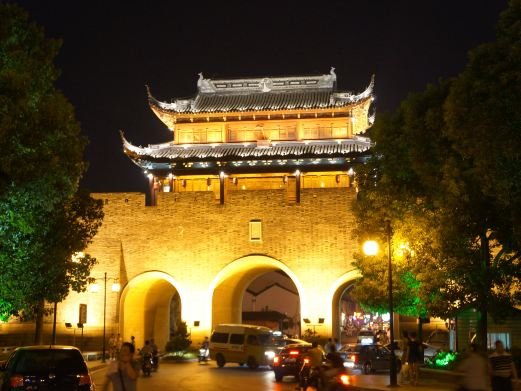
Suzhou has a total of eight water and land city gates. In addition to the previously mentioned Panmen and Xumen, there are also Chang, She, Lou, Jiang, Ping, and Qi gates. From the Qing Dynasty Qianlong period’s ‘Gusu Prosperous Map’, it can be seen that the inner city gate of Changmen faces Changmen Street (now West Zhongshi Street), with a city tower similar to that of Panmen. The outer city gate is near the drawbridge, and the enceinte is rectangular, with an additional enclosed city inside, and there are also two Tongzi gates, one to the south and one to the north. The South Tongzi gate leads to today’s South Xin Road, while the North Tongzi gate leads to the North Wharf. It is believed that during the Taiping Rebellion, the enceinte of Changmen was destroyed, leaving only the inner city and the enclosed city. In 1927, the Municipal Preparation Office’s Public Works Bureau demolished the enclosed city during construction and also removed the original narrow old city gate. In 1934, the city gate was rebuilt in the style of Jinmen’s Roman architecture, resulting in three gates for Changmen, with the middle one for vehicular traffic and the sides for pedestrian traffic. The water city gate of Changmen is to the north of the inner city gate, spanning Xiatang Street River. At the beginning of the liberation, there were wooden gates, which were removed in the 1950s, and now only the foundation of the water city gate remains. The stone step beam bridge, Julong Bridge, outside the water city gate was turned into a sluice in the early 1970s. Opening hours: Open all year round, 24 hours a day.
Related Content:
 Panmen Gate: The Unique Dual-Purpose Water and Land City Gate in Suzhou
 Changmen
 Follow Xia Ningbao to the Jiangnan water town – Zhujiajiao Ancient Town.
 Zhengzhou – Nanjing – Wuxi – Shanghai, Leisure Self-driving All the Way, Feel the Midsummer Time!
 Jiangnan Song City: Scenic Beauty, Hakka Cradle, and Fun in Ganzhou!
 Suzhou, Shanghai, Zhejiang: A 3-Person Self-Drive Adventure