
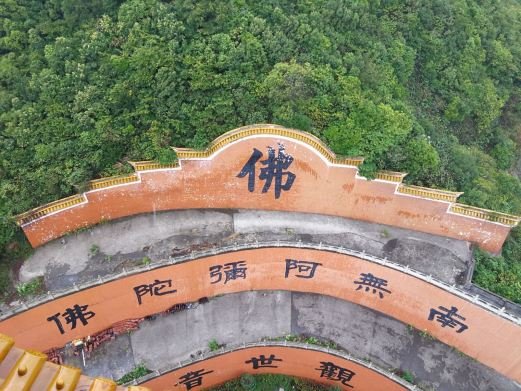
Ciyun Nunnery is located in the south of Yuepinggang Summit on Moxin Mountain. It was built during the Qianlong period (1736 – 1795) and has a history of more than 240 years. In 1983, Tao Fugen, a lay Buddhist in Gaoting, took the lead in raising funds for renovation. Chen Congzhou, a professor at Tongji University in Shanghai, rewrote the plaque for Ciyun Nunnery and composed the couplet ‘The tide has a sound, the pines listen to the rhyme; the mountains are endless, the water is boundless’. In March 1985, with the approval of the county people’s government, it became a religious tourist attraction and a cultural relic protection unit and was opened to the public.
To the west of the rear hall, there is a marble stele engraved with a poem titled ‘A Piece of Jiangchengzi – Written on Visiting Penglai Fairy Island in Daishan’ which was improvised and handwritten by Zhao Puchu, president of the China Buddhist Association, when he inspected Ciyun Nunnery in October 1989. The poem goes like this: ‘Knowing that the Buddhist land spreads over three thousand. Ascending the fairy mountain, paying respects to the golden immortal. The body appears in multiple layers, presenting the endless Huayan. With a Zen finger, the mind opens and the pavilion rises. Looking at the great sea, bluer than blue. An old monk in the sutra room is alone and at ease. Consulting again and again, showing a kind face. Recording between the tides, still silent. But remember that it is good to rest by the screen. Listen with the eyes, and the ears must observe.’
Related Content:
 West of Tibet, Towards the Scorching Mountains and Rivers
 Ciyun Nunnery
 Suzhou, Shanghai, Zhejiang: A 3-Person Self-Drive Adventure
 Zhengzhou – Nanjing – Wuxi – Shanghai, Leisure Self-driving All the Way, Feel the Midsummer Time!
 Jiangnan Song City: Scenic Beauty, Hakka Cradle, and Fun in Ganzhou!
 Winter Tour in Mingyue Mountain, Jiangxi. Play with snow on the mountain and soak in hot springs at the foot. See waterfalls and floating clouds and take a small train. Beautiful scenery and fun activities.