
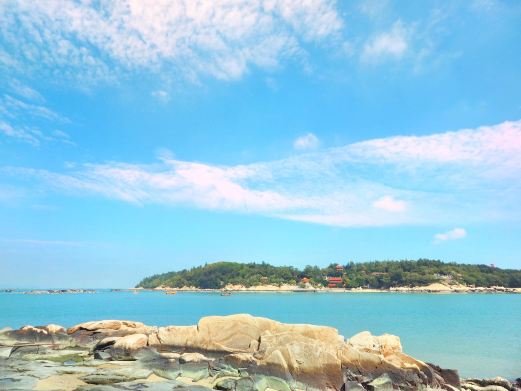
Dongmen Fishing Village faces Shipu Fishery Port across the sea, where the well-known film ‘Fisherman’s Song’ was filmed. Tourists who come to trace the film’s footsteps have the option to drive, following the coastal avenue over the Tongwa Gate Cross-Sea Bridge to Dongmen Island, or to take a ferry, passing through the harbor filled with brand-new steel fishing vessels, and within fifteen minutes, they can disembark. However, there is no trace of ‘Little Cat’s’ home from the film to be found there: a uniform row of modern houses, a sky full of masts, towering red dragon flags, and a marble monument reading ‘Zhejiang’s Number One Fishing Village’ standing by the shore, making one feel that the air here carries a modern ‘fisherman’ flavor. There is also the ‘Fisherman’s Song’ filming monument, silently conversing with your soul, leading you through time and space, and reminding you of the fishing village in the film. In the over 1000-meter-long outdoor fishing net manufacturing area, the fishing net frames are neatly arranged, impressive in their scale, and within the varying shades of green nets, there are fashionable fisherwomen weaving nets—descendants of the ‘Little Cat’ from the film with braids, who have opened up a fisherman’s fun activity—’Weaving Net Joy’ for tourists seeking the scenes where ‘Little Cat’ acted; and for those looking for the ‘braid girl’ who taught ‘Little Cat’ to row, a special ‘rowing competition’ has been set up. As you sit at the seaside dining table, gentle waves play soft music for you, and the sea breeze comes to brush away the dust from your body; as you hold your glass and taste seafood, today’s ‘Little Cats’ will tell you—the 16th of September each year marks the end of the three-month fishing ban, the first day of thousands of boats going out to sea to catch fish, and they can return with a bountiful harvest on the same day or the next, so you are welcome to come back then and taste the delicious ‘first net’ seafood from the East China Sea. Tourists who have not been to the island may not know that Dongmen Island is also a place with a deep cultural and historical heritage. Dongmen Island has a unique geographical location, serving as a barrier for Shipu, and the Dongmen Stockade established in the Song Dynasty is the first military camp in Xiangshan’s history. The island has many historical sites and relics, such as the Mazu Temple built at the foot of Laoditou Mountain at the beginning of the Ming Dynasty, covering an area of more than 2000 square meters with a construction area of 1200 square meters. There is also a peculiar custom about Mazu on the island: it is said that Mazu once visited this island, so local fishermen choose the auspicious day of Mazu’s birthday on the 23rd of the third lunar month to set sail north to the Dai Qu Ocean for fishing, holding a Mazu birthday celebration and a farewell ceremony for their loved ones going out to sea, which is rare along the coast of our country. Now this custom has evolved into an important activity in China’s Fishing Festival—the Mazu’s Peace Tour Fireworks Evening. The island also has ancient temples such as the City God Temple, General Wang Temple, and Dongmen Temple, as well as defensive walls and beacon towers built during the Song, Yuan, and Ming dynasties, recently restored Qing Dynasty ancient batteries, Cai Yuanpei statues, and inscription steles, and a sea goddess Mazu over ten meters high.
Open all year round, accessible 24/7.

Related Content:
 Shanghai Original Cast Musical ‘Cats’ CATS – Shanghai Station
 Ocean Flower Island Tourist Resort
 Jiangnan Song City: Scenic Beauty, Hakka Cradle, and Fun in Ganzhou!
 Suzhou, Shanghai, Zhejiang: A 3-Person Self-Drive Adventure
 Shanghai International Film Festival
 West of Tibet, Towards the Scorching Mountains and Rivers