
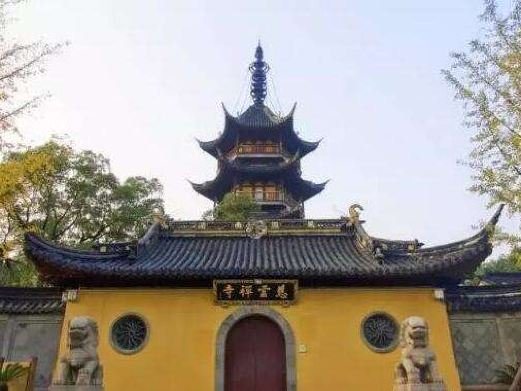
Ciyun Zen Temple was originally established in the third year of the Xiantong period of the Tang Dynasty (862 AD). During the Sino-Japanese War, the temple served as the location for the precursor to the Ningbo Daily Newspaper – the Ningbo People’s News. In 1941, Ninghai Middle School relocated here to avoid Japanese bombing. During the Cultural Revolution, a school known as ‘Huangtan May Seventh High School’ was operated here. The temple is built against the mountain with a terraced layout. Upon entering the temple gate, seven incense wheel pagodas stand in line along the road, as if welcoming the arrival of pilgrims and travelers.
The main halls within the temple include the Hall of the Heavenly Kings, the Mahavira Hall, and the Round Hall. Flanking the Mahavira Hall are symmetrical wing rooms. The eastern wing consists of twelve rooms made of brick and wood, while the western wing comprises nine rooms built with concrete. Across a courtyard from the eastern wing, there are twelve two-story rooms designated for the lodging of pilgrims. Beyond the passage of the pilgrim’s quarters, separated by a small courtyard, lies the Ksitigarbha Hall. On the western side, separated by a courtyard, is a seven-room wooden structure with traditional square columns and lattice windows, which was constructed using classical architectural materials from the renowned Cheng Ganqing’s house during the old city renovation. The dining hall is equipped with five配套 kitchens to the north. Adjacent to the west of the Round Hall, there are two two-story concrete buildings, with the upper floors serving as Buddhist venues and the lower floors as high-end lodgings for pilgrims. The total construction area is 6,000 square meters.
Related Content:
 Suzhou, Shanghai, Zhejiang: A 3-Person Self-Drive Adventure
 Follow Xia Ningbao to the Jiangnan water town – Zhujiajiao Ancient Town.
 Self-guided Tour of Five Places in Eight Days: Shanghai, Guangzhou, Zhaoqing, Macau and Nanjing
 Zhengzhou – Nanjing – Wuxi – Shanghai, Leisure Self-driving All the Way, Feel the Midsummer Time!
 National Day Holiday: Exploring the Shimao InterContinental
 Danzhou Dongpo Cultural Tourism Area