Fenghao Mansion, also known as the former residence of the Jiang family, is an important cultural landmark in Xikou Town.
Traditionally, every family in the area had a unique name for their household. The Jiang family, belonging to the ‘Zhou’ generation in the genealogy, derived their household name from the ancient capitals of the Western Zhou dynasty, Fengyi and Haojing, hoping their family would prosper as the Western Zhou did. Thus, the name Fenghao Mansion was established.

Fenghao Mansion, also known as ‘Sujiu’, earned its name because the Jiang family has been devout Buddhists, practicing vegetarianism and reciting sutras. The mansion covers an area of 4,800 square meters with a construction area of 1,850 square meters.
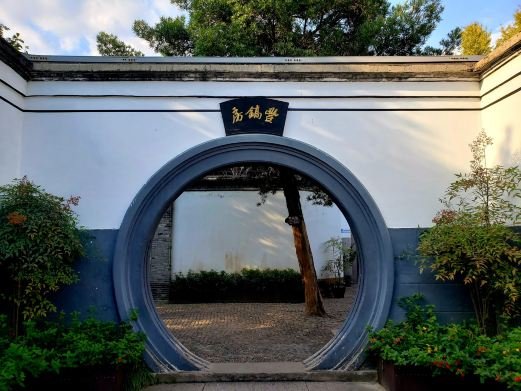
The architectural layout is traditional, featuring a front hall and a rear hall, with two side wings and four corridors. There are three gardens adjacent to the front hall, connected by moon gate doors. In the central small patio, there are two osmanthus trees, one gold and one silver, planted by Soong May-ling herself.
The eastern wing was reserved for Soong May-ling’s residence but has remained unoccupied. The western wing was the residence of Mao Fumei. Adjacent to the western wing is a separate small building, originally a three-room ancestral house, which was the former residence of Jiang’s mother, Wang Caiyu.
Out of respect for their ancestors and to preserve feng shui, all new buildings in the expansion of Fenghao Mansion were not allowed to exceed the height of this ancestral residence.
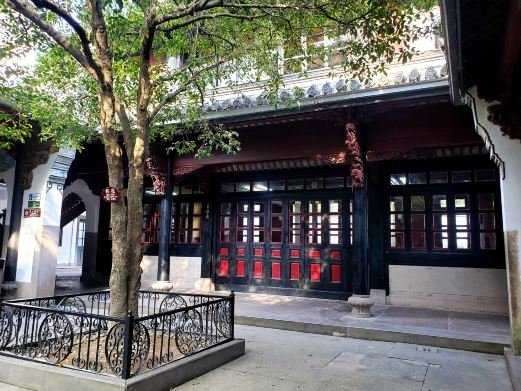
Fenghao Mansion also features three major attractions: carvings, paintings, and relief sculptures. Upon entering the front hall, one can see the central relief on the roof, flanked by ‘Two Dragons Playing with a Pearl’. The Baoben Hall, dedicated to ancestor worship and honoring the heavens, is the core of the entire Fenghao Mansion complex.
At the ends of the corridors, there are two paintings, ‘The Eight Immortals Crossing the Sea’ on the east and ‘Jiang Taigong Fishing’ on the west. The wooden carvings on both sides of the column heads depict stories from ‘Romance of the Three Kingdoms’, starting from the east with ‘Liu Bei’s Marriage’, ‘Night Battle with Ma Chao’, ‘Guan Yu’s Battle in Changsha’, and ‘Returning to Jingzhou’.
The wooden carvings on the four column heads of the eastern and western wings also draw from ‘Romance of the Three Kingdoms’, namely ‘Sending the Empress Dowager’, ‘Meeting in the Ancient City’, ‘Offering Gold on Horseback’, and ‘Beheading Yan Liang’.
The carvings on the eastern corridor depict scenes from ‘The Loyal and Brave Yue Fei’, including ‘The Great Flood in Tangyin’, ‘Apprenticing with Zhou Tong’, ‘Military Field Competition’, and ‘Yue’s Mother’s Tattoo’.
The eastern corridor’s carvings also feature a group portrait of the Eight Immortals, including Iron Crutch Li, Lu Dongbin, Han Xiangzi, and He Xiangu. There are also paintings such as ‘Wen Tai Shi Returning to Court’, ‘Chen Lin Holding a Box’, and ‘Yue Fei Accepting the Flower Spear’.
The entire complex is open to the public from 08:30 to 17:00 all year round.

 Self-guided Tour of Five Places in Eight Days: Shanghai, Guangzhou, Zhaoqing, Macau and Nanjing
 Suzhou, Shanghai, Zhejiang: A 3-Person Self-Drive Adventure
 National Day Holiday: Exploring the Shimao InterContinental
 Follow Xia Ningbao to the Jiangnan water town – Zhujiajiao Ancient Town.
 Jiangnan Song City: Scenic Beauty, Hakka Cradle, and Fun in Ganzhou!
 Zhouzhuang