
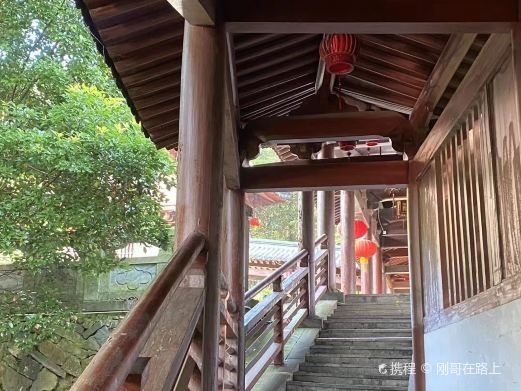
Fojisi Temple is an ancient temple located on the top of Dapeng Mountain. Regarding the origin of Fojisi Temple, it stems from a Fojisi Cave nearby. According to legend, in the first year of Tianbao in the Tang Dynasty (742), a wandering monk named Dahui came to the mountain and discovered the deserted Fojisi Cave for many years. There is a footprint of Guanyin Buddha left in the cave. Considering it a Buddhist trace, he then built this majestic temple. Originally, there were also Zhongfojisi Temple and Xiaofojisi Temple, but now only ruins remain. Nowadays, the rebuilt Fojisi Temple relies on the ‘thousand-year-old Buddhist trace’ and presents the grandeur and magnificence of the ancient temple back then. In the main axis of the Buddhist worship area of Fojisi Temple, the mountain gate, main hall, and sutra depository are arranged in sequence. The east and west corner towers, patriarch hall, Samgha hall, pharmacist hall, Amitabha hall and corridors are distributed on the left and right wings respectively, jointly forming the main Buddhist worship space of Fojisi Temple. The pilgrim dormitories, monk dormitories and chanting hall form a courtyard and are stacked in sequence from north to south. On the east side, it is composed of the abbot’s courtyard, vegetarian restaurant, bell tower, dining hall and lay Buddhist dormitories. The Guanyin courtyard is located separately at the east end. As the saying goes, ‘Worship the Buddhist kingdom by the sea in the east and pray for the blessed land of a thousand years in the west.’ The famous temple in eastern Zhejiang, Fojisi Temple, stands on the lush top of Dapeng Mountain, ensuring a safe life for pilgrims from all directions. Opening hours: Open all year round from 08:30 to 16:30. For specific opening hours, please consult the scenic area.
Related Content:
 Suzhou, Shanghai, Zhejiang: A 3-Person Self-Drive Adventure
 West of Tibet, Towards the Scorching Mountains and Rivers
 Follow Xia Ningbao to the Jiangnan water town – Zhujiajiao Ancient Town.
 Winter Tour in Mingyue Mountain, Jiangxi. Play with snow on the mountain and soak in hot springs at the foot. See waterfalls and floating clouds and take a small train. Beautiful scenery and fun activities.
 Jiangnan Song City: Scenic Beauty, Hakka Cradle, and Fun in Ganzhou!
 Zhengzhou – Nanjing – Wuxi – Shanghai, Leisure Self-driving All the Way, Feel the Midsummer Time!