
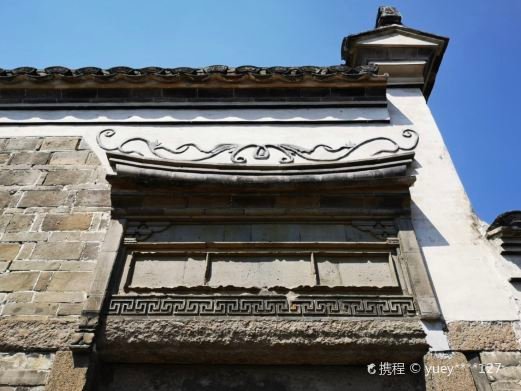
This residence was originally part of the former residence of Feng Shujix, a provincial administrative official during the Jiajing period of the Ming Dynasty. Later, due to the decline of the descendants of the Feng family, it was sold to the Ying family and the courtyard was rebuilt. On the east side of the gate, there are two screen doors in the form of a clothes hanger brocade, with architrave style. The screen wall of the second gate is at the southern end. There is a large brick-carved character ‘Fu’, so it is called ‘Fuzi Mentou’. The front hall has five bays, with a width of 18.8 meters and a depth of 9.9 meters. The central bay is of the post-and-lintel construction. A pillar is supported on the flat beam. The lower end of the child pillar under the front middle column’s purlin is tongue-shaped, while the child pillars under the front and rear upper purlins are square. The front column capitals of the rear gold columns are all decorated with cross-shaped ornaments. The front eaves columns are small octagons, and below are square waist-edged column bases. The rest of the columns are all flat-pearl-shaped. The column capitals are chamfered. The gaps between the beams are filled with reeds as the core, and plastered with husks and mud. It has a hard mountain roof. Beside the two rear eaves columns at the back of the central bay, there are walls in the shape of the Chinese character ‘八’. At the upper end, brick carvings are made into brackets. In the middle of the back wall, there is a door in the form of a brocade. On the lintel facing north, there is an inscription. The upper part reads ‘In the winter month of Yichou’. The middle part reads ‘The grace flows and thoughts are compliant’. The lower part reads ‘Inscribed by Chen Mingbao’. The back part is a ‘courtyard with three sides’, with left and right wing rooms, all of which are storied buildings. According to research and verification, the front hall has the characteristics and style of Ming Dynasty architecture, and the back building has the style of the early Qing Dynasty. So far, it is still relatively intact.
Related Content:
 Self-guided Tour of Five Places in Eight Days: Shanghai, Guangzhou, Zhaoqing, Macau and Nanjing
 Jiangnan Song City: Scenic Beauty, Hakka Cradle, and Fun in Ganzhou!
 National Day Holiday: Exploring the Shimao InterContinental
 New Summer Attractions at Shanhaiguan
 Lin Residence
 Suzhou, Shanghai, Zhejiang: A 3-Person Self-Drive Adventure