
Located 10 kilometers away from Wuyi County, Guo Dong Ancient Ecological Village is said to be an ancient village built by the descendants of He Zhizhong, a prime minister from the Song Dynasty, who imitated the ‘Inner Sutra Map’. The village’s bridges and wells are meticulously arranged according to the terrain. Speaking of scenery, the lush forests and mottled moss of Guo Dong offer a fresh and deep feeling, with few traces of later embellishments. There are numerous ancient buildings from the Ming and Qing dynasties, making it one of the villages worth visiting in Wuyi. Upon entering the village, the first thing that catches the eye is the Hui Long Bridge, which features an exquisite pavilion and a plaque hanging with the word ‘Yi Xiang’. Ivy climbs the bridge, and beneath it flows a murmuring stream, exuding an ancient charm and becoming a favored photo subject for tourists.
Beside the bridge, at the foot of the mountain, is the Hai Lin Courtyard, with a statue of Guan Yu and murals in front, and a statue of Guanyin in the backyard. Visitors may be advised to burn incense upon entering the courtyard, but a polite refusal is acceptable if one does not intend to do so. Beyond the Hai Lin Courtyard, the small mountain behind it is the Long Mountain Primeval Forest. Although the mountain is only a few hundred meters high, it is home to a large number of valuable plants such as southern camphor trees and bitter chestnuts, many of which are ancient trees that are five to six hundred years old. Looking through the dense foliage at the continuous eaves and horse-head walls of Guo Dong Village below, one can better understand why people say it is ‘surrounded by mountains like a city wall, and deep like a cave’. The air in the forest is excellent; taking a few deep breaths is very refreshing. Following the trail within the primeval forest for about 30 minutes, one will soon reach the Fan Yu Hall (New House Hall) and Ren Lan Hall. The peony and flower window carvings in Fan Yu Hall are exquisite, yet they have an additional sense of casualness and unconstraint compared to typical wood carvings. Ren Lan Hall is named after ‘Li Sao’, and instead of using eaves columns and hanging columns to support the eaves, it uses ox legs to support small beams, which is quite unique.
In the He Clan Ancestral Hall, there are ninety-seven plaques, but unfortunately, most were severely damaged in the past. Only four plaques, including ‘Respect and Encourage Learning’ and ‘Yi Zhong Ru Lin’ from the Daoguang period, are original, while the rest are replicas. However, when you step into the hall and look up at the full room of plaques, it is still quite striking. The ancient stage in the hall is elegant and simple, and the decorations on the ridges and eaves are also exquisite and unique. Going east from the He Clan Ancestral Hall, one can see a Christian church, and the large hall opposite often gathers villagers doing handwork and chatting. Many of the mud-walled, blue-tiled residences by the stream exude an ancient charm, making them suitable for photography. Walking along the road outside the village leads to the Jie Xiao Archway and Wen Chang Pavilion. Guo Dong’s local accommodation and catering services are well-developed, with farmhouse standard rooms costing around a hundred yuan, although not many guests stay overnight. The dining is famous for bamboo tube rice and stewed local chicken, which can be purchased at most restaurants near the village. In particular, the bamboo tube rice, stuffed with rice, goji berries, and dried vegetables in a bamboo tube and baked over a fire for an hour, is fragrant and delicious.
Open all year round from January 1st to December 31st, 08:00-17:30. For preferential policies and additional information, please refer to the information disclosed by the scenic area on the day. Essential tips: Guided tours are available within the scenic area.
Related Content:
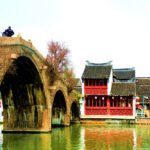 Follow Xia Ningbao to the Jiangnan water town – Zhujiajiao Ancient Town.
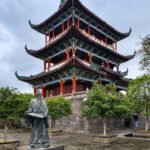 Jiangnan Song City: Scenic Beauty, Hakka Cradle, and Fun in Ganzhou!
 Suzhou, Shanghai, Zhejiang: A 3-Person Self-Drive Adventure
 West of Tibet, Towards the Scorching Mountains and Rivers
 National Day Holiday: Exploring the Shimao InterContinental
 Qingxi Country Park, A Good Place for Autumn Outings