

The Guyuan Ren Cave is a natural karst cave that was discovered in 1993 during mountain quarrying. It is named ‘Gourd Cave’ due to its resemblance to a gourd. The cave can be divided into six main sections, including the stone wall sculpture spring landscape at the entrance, the ancient human stone carving garden at the foot of the mountain, the ancient human historical materials exhibition hall, the ancient human carving landscape at the cave mouth cliff, the natural karst cave landscape, and the bamboo garden leisure area.
The stalactites and stalagmites inside the cave are of various shapes and well-developed, with the red and white colored ones being extremely rare in the world. However, what is precious in the cave are two skulls that date back to 580,000 to 620,000 years ago, confirming that this is a complete ancient human activity site found in Jiangnan to date, which is the same period as the Peking Man site in Zhoukoudian, Beijing. The human history of the Nanjing area has thus been pushed forward by more than 200,000 years, and it also confirms that the Yangtze River Basin is one of the cradles of the Chinese nation.
Fossils found in the cave also include more than ten species such as肿骨鹿 and 斑鹿, which mostly lived in the middle Pleistocene about 1.5 million years ago. Nowadays, on the top of the cave mountain, two or three giant bronze statues of apemen hunting have been cast, serving as a giant symbol of the Guyuan Ren Cave. Throughout the scenic area, one can see primitive buildings such as thatched huts, stone tools, nest houses, and cave dwellings, filled with a sense of history.
Related Content:
 Suzhou, Shanghai, Zhejiang: A 3-Person Self-Drive Adventure
 Winter Tour in Mingyue Mountain, Jiangxi. Play with snow on the mountain and soak in hot springs at the foot. See waterfalls and floating clouds and take a small train. Beautiful scenery and fun activities.
 West of Tibet, Towards the Scorching Mountains and Rivers
 Follow Xia Ningbao to the Jiangnan water town – Zhujiajiao Ancient Town.
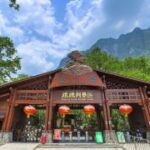 E’xianling Ecological and Cultural Tourism Area
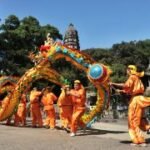 Huqiu Mountain Scenic Area