
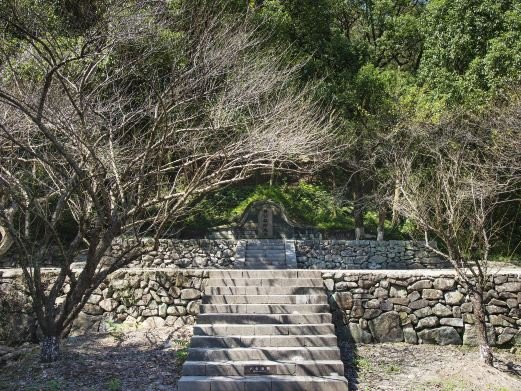
After the failure of the anti-Qing struggle, Mr. Li Zhou built Longhu Mountain thatched cottage in Hua’an Mountain in his later years, engaging in reading and writing. In the winter of the 27th year of the Qing Kangxi era (1688), when the master was 79 years old, he found his own burial place here and built an extremely simple grave. Mr. Zhou also wrote ‘The Last Will of Li Zhou’ and ‘Questions on Funeral Rites’ to admonish his descendants, stating that after his death, he should be buried in the clothes he usually wore, with ‘one quilt and one mattress, placed on a stone bed, without a coffin, no Buddhist services, no sevens, and no drums, witches, or inscribed banners.’ Following his instructions before his death, his body was buried in the cave without a coffin, and no tombstone was erected. The epitaph was written by the famous historian of the early Qing Dynasty, Quan Zuwang from Yin County, and the tomb inscription was written by Mao Qiling from Xiaoshan. During the Cultural Revolution, Huang Zongxi’s tomb was destroyed. In 1981, it was partially restored. The tomb faces west and southeast, with the front resembling a lotus leaf gable wall, made of interlocking stone slabs. In the middle, there is a vertical stone tombstone with the seven characters ‘Tomb of Mr. Huang Li Zhou’ inscribed in official script. In front of the tombstone, there is a stone sacrificial table, a worship platform paved with pebbles, and a stone bench on each side. Surrounding the tomb are towering mountains, with green shade blocking the sun, giving a solemn and quiet feeling. Huang Zongxi (1610-1695), styled Tai Chong, also known as Li Zhou and Nan Lei, was from Yuyao, Zhejiang. His father, Huang Zun Su, was a Jinshi during the Wanli era, and an imperial censor during the Tianqi era. He was a member of the Donglin Party and was stripped of his position and returned home due to his impeachment of Wei Zhongxian. He was later imprisoned and died under torture. At the age of nineteen, Huang Zongxi went to the capital to appeal his father’s injustice, and in the public court, he used a pick to injure the main conspirator and pursued the murderer. The Ming Emperor Si Zong praised him as ‘a loyal minister’s lonely son.’ After Huang Zongxi returned home, he studied harder and learned from the famous philosopher Liu Zongzhou, acquiring the knowledge of Ji Mountain. After the Qing army entered the pass, Huang Zongxi gathered hundreds of local young people to form the ‘Shi Zhong Camp’ to participate in the anti-Qing battle for several years. After the failure, he returned home to write and the Qing court repeatedly summoned him, but he declined. The entire text is open all year round from 8:00 to 17:00, subject to the actual situation on the day.
Related Content:
 Suzhou, Shanghai, Zhejiang: A 3-Person Self-Drive Adventure
 Follow Xia Ningbao to the Jiangnan water town – Zhujiajiao Ancient Town.
 Self-guided Tour of Five Places in Eight Days: Shanghai, Guangzhou, Zhaoqing, Macau and Nanjing
 National Day Holiday: Exploring the Shimao InterContinental
 Jiangnan Song City: Scenic Beauty, Hakka Cradle, and Fun in Ganzhou!
 Zhouzhuang