
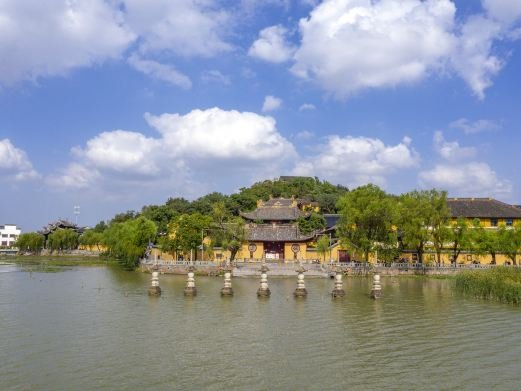
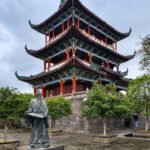
An ancient temple with a history of thousands of years – Jinxian Temple. It was established in the Liang Dynasty of the Southern Dynasties and has a history of thousands of years. After several destructions and reconstructions, its style remains unchanged. The temple gate is facing Baiyang Lake. A pair of stone lions in front of the gate are gazing longingly at the still clear and blue lake water that has endured for thousands of years. Whenever the setting sun shines from the west, the setting sun is like blood, and the surrounding area is completely silent. The deep and resonant bell sound drifts over slowly, carrying the patina of a thousand years and filling every corner. Tired birds fly across the lake and through the bell sound, returning to their nests. According to the records of Cixi County in the Guangxu period of the Qing Dynasty: The temple was initially built in the Datong period of the Liang Dynasty in the Southern Dynasties and has a history of more than 1,400 years. It was originally named Jingjin Nunnery. During the Qianyuan period of the Tang Dynasty, Zen Master Fulin Duozhi lived here and renamed it Fulin. In the second year of Zhiping in the Song Dynasty, because Baiyang Lake was once named ‘Jinxian Lake’, the imperial court bestowed the name Jinxian Temple and it became a famous temple in eastern Zhejiang at that time. In the 38th and 59th years of the Kangxi period of the Qing Dynasty, it was expanded twice. In the 15th year of Daoguang, it was destroyed by fire and soon rebuilt. In the first year of Tongzhi, it was destroyed again by war. In the 12th year of Tongzhi, it was rebuilt. In the 1980s, Yao Yunlong and his wife, believers from Cixi living in Hong Kong, considering that Jinxian Temple is located in the Baiyang Lake scenic area, decided to donate money to renovate the temple. In the nearly ten years since then, the Buddha hall, Heavenly Kings Hall, Wanghu Tower, Baihu Lecture House and guest rooms on both sides have been restored. And new buildings such as the Jade Buddha Pavilion and Ten Thousand Buddha Tower have been built. Now there are 172 halls and rooms of various kinds, covering an area of 42 mu. The halls are magnificent and the Buddha statues are solemn, becoming a relatively large-scale monastery in eastern Zhejiang.
Open all year round and open all day.
Related Content:
 Suzhou, Shanghai, Zhejiang: A 3-Person Self-Drive Adventure
 West of Tibet, Towards the Scorching Mountains and Rivers
 Self-guided Tour of Five Places in Eight Days: Shanghai, Guangzhou, Zhaoqing, Macau and Nanjing
 Whispers of the Great Mountains: A 3-Day Self-Driven Tour in Liangshan Yi Autonomous Prefecture
 Follow Xia Ningbao to the Jiangnan water town – Zhujiajiao Ancient Town.
 Jiangnan Song City: Scenic Beauty, Hakka Cradle, and Fun in Ganzhou!