

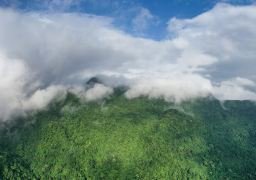
Limu Mountain National Forest Park is renowned for its numerous waterfalls and spans a vast area, divided into Yingge Ridge Scenic Area, Jinxiu Valley Scenic Area, Tianhe Scenic Area, Diaoling Ridge Scenic Area, and Limu Stone Scenic Area, each predominantly consisting of virgin forests.
Tourism Guide: 1. General vacationers can visit the ancient forest near the forest park management office or Binlang Lake. Both locations are not difficult to walk to, with a round trip to Binlang Lake taking about an hour. 2. Behind the ancient forest lies Yingge Ridge Scenic Area of Limu Mountain, but most people can only stroll along the edge of the forest since it has not been fully developed. To traverse the ancient forest, it would take at least two days. 3. Tianhe Scenic Area, Diaoling Ridge Scenic Area, and Limu Stone Scenic Area are currently accessible to tourists. It would take at least two days to visit all three, with one day allocated to climbing the main peak of Limu Mountain and the other to viewing the Diaoling Ridge Waterfall and visiting Limu Temple. Walking about 6 kilometers south from the forest management office, one can reach the Diaoling Ridge Waterfall. The path to the waterfall is mostly downhill and relatively easy to walk. During the flood season, the Diaoling Ridge Waterfall has a drop of several hundred meters. Since visitors observe it from the bottom looking up, it appears very spectacular even during the dry season.
On Limu Mountain, there is Limu Temple, which enshrines the statue of the Goddess Limu Niangniang. Every year during the ‘March 3rd’ festival, people from various parts of Hainan gather on Limu Mountain to worship Limu, making this annual gathering in the deep mountains distinctive. The origin of ‘Limu Mountain’ is said to be that the seven fairies from heaven once visited this mountain. Among them, the peach blossom fairy was captivated by the beauty and richness of the mountain, believing it to be a place to propagate humanity. She transformed into a golden southern snake and laid an egg, which was later split open by Lei Gong, and a girl emerged, known as Limu, from whom the Li people were born. According to ancient astronomers and geographers, one of the twenty-eight constellations, the Niu constellation, corresponds to Limu Mountain, hence the ancient name ‘Limu Mountain’.
Related Content:
 West of Tibet, Towards the Scorching Mountains and Rivers
 Qingxi Country Park, A Good Place for Autumn Outings
 Spring Outing and Admiring Flowers, Live up to the Spring Scenery. A Brief Note on Cherry Blossom Appreciation in Wuxi, Jiangsu in March 2023
 Chongming Mingzhu Lake Park
 Follow Xia Ningbao to the Jiangnan water town – Zhujiajiao Ancient Town.
 Jiangnan Song City: Scenic Beauty, Hakka Cradle, and Fun in Ganzhou!