
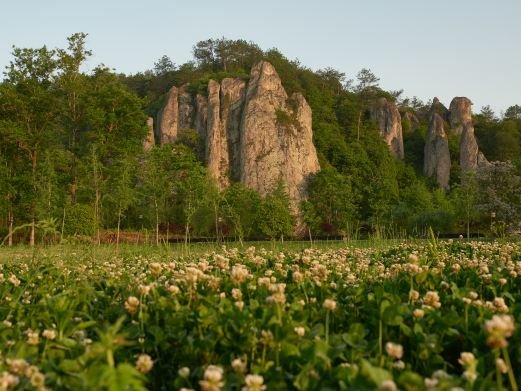
Chu Yang Valley is home to three exquisitely connected stone caves, known as the ‘Three Orifices of Yang Valley’, which are as round and translucent as rice sifters. Every sunrise, a miraculous beam of sunlight penetrates through all three caves. Entering from the ‘Half Wall Pond’ and ascending the winding path and stone steps, one arrives at the main cave. The main cave is tall and spacious, with a dome-like ceiling and a flat floor. In front of the cave, there is a massive rock that acts as a screen, creating a serene and elegant stone chamber. The cave’s ceiling features a bowl-sized hole, believed to be where ancient scholars hung their lamps for night reading. The cave preserves numerous cliff inscriptions left by literati and calligraphers since the Tang Dynasty, including various styles such as running script, regular script, clerical script, and seal script, making it a dazzling display. Among the inscriptions is the precious ‘Ni Weng Cave’ in small seal script, inscribed by Li Yangbing, a Tang Dynasty calligrapher (who once served as the magistrate of Jinyun County). It is said that an official with the surname Ni, who despised the worldly ways, secluded himself here but left no name. When Li Yangbing served as the magistrate of Bo Yun County during the Tang Dynasty, he named the cave after Ni Weng and inscribed ‘Ni Weng Cave’ in 759 AD on a large rock at the cave’s entrance. Later generations built the ‘Ping Xu Pavilion’ to protect the calligraphy, which remains undamaged to this day, with clear and legible characters. Ming Dynasty officials, including the Minister of Justice Qiao Zhi (styled Xu Shan) and the Censor Fan Xianke (styled Dou Shan), also once secluded themselves in the ‘Two Valleys Cave’, hence the inscriptions of ‘Xu Shan’ and ‘Dou Shan Dong Tian’ on the stone walls. In April 1980, the Jinyun County Committee classified the ‘Ni Weng Cave’ and the cliff inscriptions in the Xian Du Scenic Area as historical relics for enhanced protection. Other attractions at the Ni Weng Cave site include ‘Rat Stealing Oil’, ‘Du Feng Academy’, ‘Asking Fishing Pavilion’, ‘Uncle’s Sedan Rock’, and ‘Moon Mirror Rock’. Moon Mirror Rock: Between Dong Meng Rock and the Five Elders Peak, there is a cluster of rocks resembling a group of fairies, facing the ‘Moon Mirror’ on Hao Mountain, grooming themselves, thus named ‘Fairy Grooming’. It is said that in ancient times, a group of fairies, feeling lonely in heaven, wanted to come down to earth to play. They groomed and dressed in front of the Jade Platform and then sang and danced, with their music reaching the mortal world. In the north, a monk practicing in the Turtle Cave heard the delightful fairy music and stealthily went to the Immortal Reef to peek, seeing the fairies happily singing and dancing, staring straight ahead, entranced. Thus, he became a fossil. The entire site is open from 4/29 to 10/31 (peak season) from 07:30 to 17:30; from 11/1 to 4/28 (off-season) from 08:00 to 17:00.
Related Content:
 Jiangnan Song City: Scenic Beauty, Hakka Cradle, and Fun in Ganzhou!
 Suzhou, Shanghai, Zhejiang: A 3-Person Self-Drive Adventure
 National Day Holiday: Exploring the Shimao InterContinental
 Follow Xia Ningbao to the Jiangnan water town – Zhujiajiao Ancient Town.
 Shanghai Yang Liping’s 2022 Dance Drama ‘Peacock’
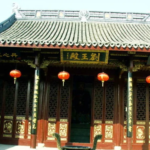 Jingxing Rock