
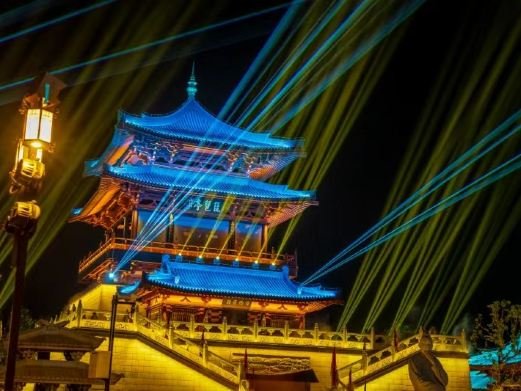
On an autumn night in the 11th year of the Yuanhe era of the Tang Dynasty (816 AD), Bai Juyi, the Magistrate of Jiangzhou, was seeing off a guest by the Xinyang River when he suddenly heard the melancholic and emotional sound of a pipa from a neighboring boat, touching his heart. He moved his boat to meet and found that it was a singing girl from the capital. Bai Juyi prepared wine and dishes again, inviting the woman to play a tune, listening to the wonderful music. While talking about their life stories, he learned that the pipa player had married a merchant in her old age and was left alone at the river mouth. Bai Juyi, associating the pipa player’s unfortunate life with his own ups and downs, felt a mix of emotions and uttered the sigh, ‘We are both castaways at the ends of the earth, why need we have known each other before?’ Inspired by his emotions, he wrote the immortal poem ‘The Song of the Pipa Player’. In memory of this poet, the people of Jiangzhou built the Pipa Pavilion at the place where he ‘sent off guests at night by the Xinyang River’. Over a thousand years, the Pipa Pavilion was built and destroyed many times, and it was rebuilt in the spring of 1988. The rebuilt Pipa Pavilion is located to the east of the Jiujiang Yangtze River Bridge, covering an area of 3,300 square meters, and is a Tang Dynasty-style garden architecture. The main building, the Pipa Pavilion, is situated on a granite foundation more than two meters high. The pavilion is hexagonal and double-storied, with green tiles and red pillars, upturned corners and heavy eaves, surrounded by white stone railings, giving a sense of solemn stability. The golden and shining ‘Pipa Pavilion’ three large characters on the huge plaque are written by the contemporary art master Liu Haisu. On the couplets, there is a collection of sentences by the Qing Dynasty literati Dong Yunyan: ‘One stroke of the water, one stroke of the moon, half into the river and sky, half into the clouds’, integrating the sound of water, wind, river and sky, clouds, and the evening moon around the Pipa Pavilion, with paintings in the couplets, thought-provoking. Inside the pavilion, there are displays of Bai Juyi’s poetry and pictures of his whereabouts in Jiangzhou. On the platform, there is a 3-meter-high white marble statue of Bai Juyi. The poet is thoughtfully looking down, with a graceful demeanor. On both sides of the Pipa Pavilion, there are corridors with inscribed poems and writings by many literati since the Tang Dynasty who came to mourn the ancient Pipa Pavilion. The full text is open all year round from 09:00 to 19:30. Preferential policies: Children: Children aged 6 years old (inclusive) or under 1.2 meters in height with valid identification are free; Minors/Students: Minors aged 6 years old (exclusive) to 18 years old (inclusive) with valid identification; full-time undergraduate and below students with valid student certificates, half price; Elderly: Elderly aged 65 years old (inclusive) and above with valid identification are free; Military personnel: Active military personnel, retired military officers, disabled military personnel, and those who enjoy pensions and living allowances with valid identification enjoy free benefits.
Related Content:
 Zhouzhuang
 Suzhou, Shanghai, Zhejiang: A 3-Person Self-Drive Adventure
 839th Episode: Bustling Eastern Water Capital, Twin Dragons Play Pearls on the Huangpu River Beach
 Panmen Gate: The Unique Dual-Purpose Water and Land City Gate in Suzhou
 Jiangnan Song City: Scenic Beauty, Hakka Cradle, and Fun in Ganzhou!
 National Day Holiday: Exploring the Shimao InterContinental