
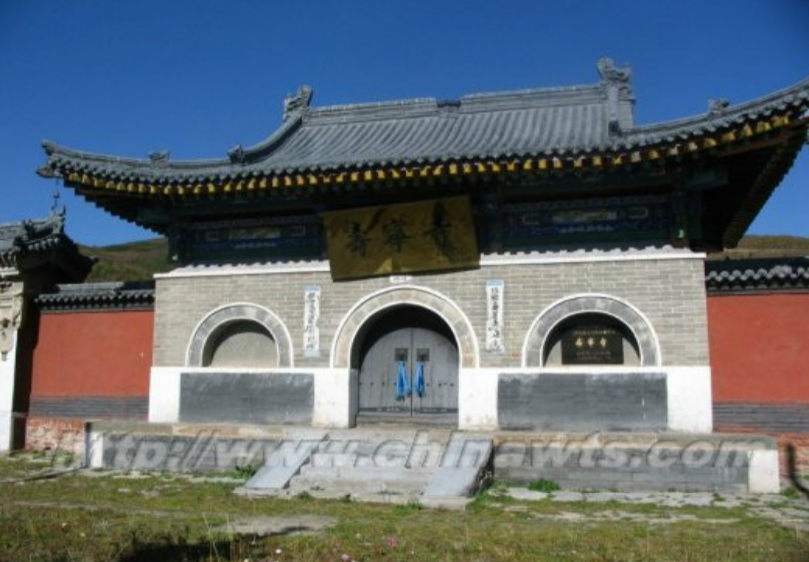
In the first year of the Yixi era of the Jin Dynasty (405 AD), the Indian monk Tanyou crossed the sea from Tianzhu (ancient India) on a raft made of maple wood, landing at Baiqiao Port in Sanmen Bay. After landing, the raft drifted to the opposite shore, which is now known as Maple Raft Mountain (opposite Gangtou Temple). At that time, Tanyou felt thirsty and could not find any fresh water. He struck the ground with his Zen staff, causing a spring of clear water to gush forth, and thus the Whitewater Hermitage was built. Today, the temple still preserves two ancient relics: the stone of Tanyou and the White Spring Well. The White Spring Well is about 1.5 meters above the ground, yet it never dries up and is used by the villagers for drinking water. The White Spring Well is also known as the Intestine Washing Well. It is said that when Tanyou’s mother was pregnant, she passed through an onion garden, and the foul smell offended the fetus. Drinking the water from the White Spring Well could remove the foulness. The Buddhist precept against eating onions, garlic, and other pungent foods also originates from this story. Later, Tanyou went along the Ninghai Baixi River into the heart of Tiantai Mountain and successively established several Buddhist temples, including Yongfu, Keshan, Shi Liang, Chicheng, Wannian, Duo Bao, Guangrun, and Qingju, becoming the founder of the Tiantai Buddhist sect, which predates the Tiantai Guoqing Temple by more than 100 years (Tiantai Guoqing Temple was built in 598 AD). During the Tang Dynasty, Jianzhen stayed here during his fourth voyage to the east. In Japanese, it is translated as Hakusen-ji Temple. The temple became a cultural exchange port between China and Japan after ferrying the monks Daran and Jiayin between 983 and 988, and in the first year of the Chunhua era (990), Wang Huaiji, a court official, petitioned to change its name to Shouning Temple. In the first year of the Zhi Dao era (995), Emperor Taizong of the Song Dynasty sent an imperial servant, Fei Yu, to bestow 30 scrolls of imperial calligraphy to Shouning Temple as a reward. In the Song Dynasty’s ‘Chicheng Ji’, Shouning Temple was ranked the second among the monasteries in Ninghai (only Songjiao Temple and Zongjiao Temple, the Dharma field of the Chan master Zunshi, were referred to as temples, while the other 44 were called monasteries). After several periods of rise and fall, the temple was burned down in 1958 and was recently rebuilt by Jue Hui, the abbot of Gaoming Temple and the president of the Taizhou Buddhist Association. It was officially opened to the public on August 13, 1933. The temple now has main buildings such as the Hall of the Heavenly Kings and the Mahavira Hall, as well as the East Ferry Memorial Hall, which preserves the statue of Sakyamuni from the time of the eastward journey. On June 9, 1999, representatives from the China-Japan International Buddhist Tourism Line Seminar visited and unanimously confirmed that Shouning Temple is an important commemorative place for the spread of Buddhism to the world and for Sino-Japanese friendship. Mr. Murakami Hiroshi, a Japanese friend, unveiled the stone tablet marking ‘The Landing Site of the Japanese Master Daran’, accompanied by He Siyuan, the director of the Zhejiang Tourism Bureau, and other provincial, city, and county officials, reviving the glory of the Sino-Japanese friendly port. The specific opening hours and business status are subject to the day’s opening conditions.
Related Content:
 Suzhou, Shanghai, Zhejiang: A 3-Person Self-Drive Adventure
 Discover the Magic City’s Winter Hot Spring Journey with a Genuine Urban Spa
 Follow Xia Ningbao to the Jiangnan water town – Zhujiajiao Ancient Town.
 Jiangnan Song City: Scenic Beauty, Hakka Cradle, and Fun in Ganzhou!
 National Day Holiday: Exploring the Shimao InterContinental
 West of Tibet, Towards the Scorching Mountains and Rivers