
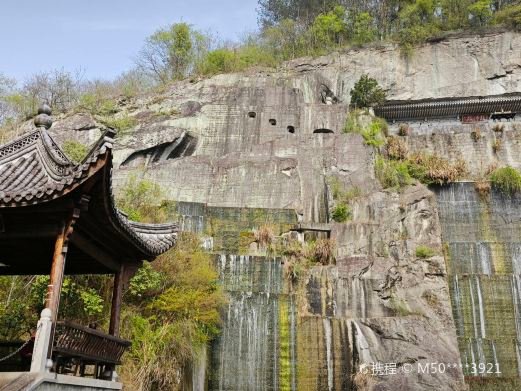
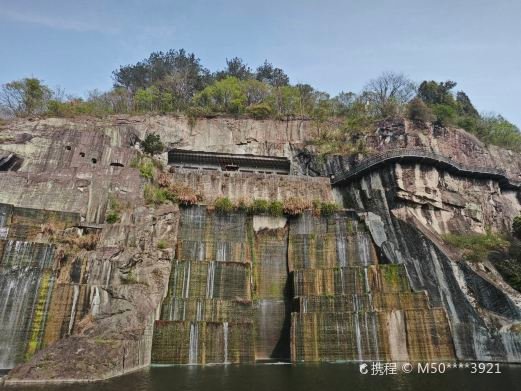
Shuanglin Grottoes is a newly established scenic spot in the Dafo Temple Scenic Area, following the open-air Maitreya, Prajna Valley, and Dinosaur Park. This site, once a quarry during the Ming and Qing dynasties, has been transformed with the construction of plank roads, tunnels, and the creation of Buddhas against the mountain, resulting in the large cave space and massive reclining Buddha statue that are present today. The Reclining Buddha Hall has become another tourist attraction themed around Buddhist culture after the ‘First Buddha of Jiangnan’, adding luster to the ‘Yue Kingdom Dunhuang’ Dafo Temple.
From the entrance of Dafo Temple, 300 meters to the left, the first sight is the stone tablet of Shuanglin Grottoes. Beyond the tablet lies the Mirror Lake. Ascending from the left, after climbing 200 steps and passing through the winding and secluded rock caves, one arrives at the hall’s front. The hall’s gate is divided into seven sections, majestic and solemn, with a single eave and double upturned ends, intricate brackets, and well-proportioned, reflecting the architectural style of the Tang Dynasty. On the left and right cliffs, relief techniques are used to carve the 7-meter-tall figures of the ‘Heng’ and ‘Ha’ generals, grand in scale and heroic in demeanor.
Upon entering the arched gate is the front hall, with the two caves on the left and right being the Bodhisattvas Manjushri and Samantabhadra. Manjushri rides a blue lion, symbolizing fierceness, holding scriptures, and is the foremost disciple of the Buddha, known for his wisdom and eloquence, assisting in the propagation of the Buddha’s teachings and leading among the Bodhisattvas. Venerating Manjushri can dispel ignorance and seek a wise heart, unlocking wisdom. Samantabhadra sits on a six-tusked white elephant, symbolizing peace and spiritual power, and represents the truth. The heads of both the blue lion and the white elephant face outward, indicating the protection of the Buddhist teachings.
Related Content:
 Suzhou, Shanghai, Zhejiang: A 3-Person Self-Drive Adventure
 Self-guided Tour of Five Places in Eight Days: Shanghai, Guangzhou, Zhaoqing, Macau and Nanjing
 Putuo Mountain Scenic Area
 Donglin Temple
 Yufo Temple
 Winter Tour in Mingyue Mountain, Jiangxi. Play with snow on the mountain and soak in hot springs at the foot. See waterfalls and floating clouds and take a small train. Beautiful scenery and fun activities.