
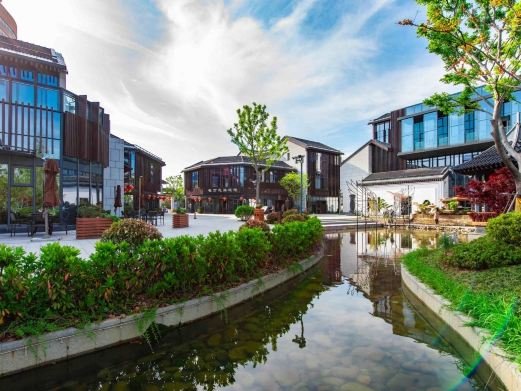
Located in the mountain recess near the peak of Daochang Mountain in the south of Huzhou City. It is included in the “Top Five Mountains and Ten Monasteries” and is one of the ten famous monasteries in Jiangnan, having a significant influence in the Buddhist circles of Japan and Southeast Asian countries.
Wanshou Zen Temple was originally built during the middle of the Tang Dynasty (881-884), and during the Five Dynasties, it was inscribed by the King of Wuyue as the “Wuxing Zhengzhen Zen Court”. During the JiaTai period of the Song Dynasty (1201-1204), it was renamed as “Miaojue Temple”. Emperor Ningzong of the Southern Song Dynasty (1195-1224) decreed the highest rank of Zen temples in the country as the “Top Five Mountains and Ten Monasteries”, with Wanshou Zen Temple ranking second among the ten monasteries. At the end of the Yuan Dynasty, Wanshou Temple was destroyed by war. The monk Zhengyin persuaded the reconstruction, which was completed in the first year of the Zhizun era of the Yuan Dynasty (1330). According to the Qing Dynasty Xianfeng “Wucheng County Records”, after the reconstruction, Wanshou Temple had five Dharma halls and seven monks’ halls. It also built a granary building, a fragrant accumulation cabinet, Qingshan Hall, Meitan Forest, Meng Hall, and the Hall for Selecting Monks, and later added a Guanyin Hall. In the third year of the Hongwu period of the Ming Dynasty (1370), it was rebuilt again. In 1984, the reconstruction of Wanshou Temple began, and in 1997, the Thousand-Hand Guanyin statue was completed. In 1996, the Mahavira Hall was completed. Wanshou Temple has once again become a famous monastery in Jiangnan. The opening hours and specific business status are subject to the daily opening conditions.
Related Content:
 Suzhou, Shanghai, Zhejiang: A 3-Person Self-Drive Adventure
 Jiangnan Song City: Scenic Beauty, Hakka Cradle, and Fun in Ganzhou!
 West of Tibet, Towards the Scorching Mountains and Rivers
 Follow Xia Ningbao to the Jiangnan water town – Zhujiajiao Ancient Town.
 Self-guided Tour of Five Places in Eight Days: Shanghai, Guangzhou, Zhaoqing, Macau and Nanjing
 Winter Tour in Mingyue Mountain, Jiangxi. Play with snow on the mountain and soak in hot springs at the foot. See waterfalls and floating clouds and take a small train. Beautiful scenery and fun activities.