
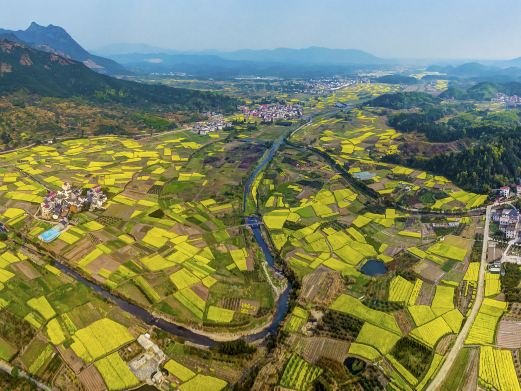
Zhiyan Village, originally built during the Southern Song Dynasty, has a history of over 800 years. It was formerly known as Zhixi Village due to the presence of Zhi Creek and a water dam within the village. This ancient village, located at the border of Lanxi and Jiande, was once a bustling post station on the ancient road from Yanzhou to Jinhua. However, like many villages whose fortunes changed with transportation, the construction of highways led to the obscurity of the ancient path, and Zhiyan fell silent. This silence has allowed the preservation of ancient architecture in its entirety.
Zhiyan Village is known as the ‘Little Lijiang of the South of the Yangtze’. Like Lijiang, every household in Zhiyan has meandering waterways in front of their doors, but the water in Zhiyan is much clearer. As you walk through the village alleys, the sound of water is a constant companion. The age, quantity, exquisite structure, and complete preservation of the ancient buildings in Zhiyan Village are rare. The village boasts nearly a hundred ancient buildings, including Yan De Hall, Xiao Si Hall, and Cheng Xian Hall, and it is a concentration of various architectures from the Yuan, Ming, and Qing dynasties, earning it the title of ‘A Typical Museum of Chinese Ancient Residential Architecture’. It is praised by architectural research experts as ‘a living fossil’ in architectural research and ‘a village of architectural treasures from four dynasties’. Representative buildings include ‘Xiao Si Hall’, ‘Yan De Hall’, ‘Ji Mei Hall’, and ‘Cheng Zhi Hall’, each with distinctive structures and well-preserved. Xiao Si Hall, the Chen family’s ancestral hall, consists of three sections with a central axis featuring a front hall, main hall, and rear hall, flanked by side rooms. The main hall spans three bays with a surrounding veranda and a hip roof. The residential buildings in Zhiyan Village provide significant physical materials for the study of traditional village culture and the evolution of residential architecture.
Related Content:
 Jiangnan Song City: Scenic Beauty, Hakka Cradle, and Fun in Ganzhou!
 Suzhou, Shanghai, Zhejiang: A 3-Person Self-Drive Adventure
 839th Episode: Bustling Eastern Water Capital, Twin Dragons Play Pearls on the Huangpu River Beach
 Follow Xia Ningbao to the Jiangnan water town – Zhujiajiao Ancient Town.
 National Day Holiday: Exploring the Shimao InterContinental
 West of Tibet, Towards the Scorching Mountains and Rivers